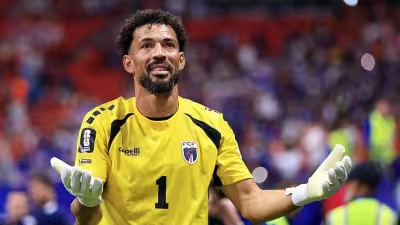
“In a system that Barcelona plays, if they have Rayan Cherki on top of Lamine Yamal, Raphinha, maybe a striker, and behind [Frenkie] de Jong and Pedri, that's insane. That's absolutely insane.” Frank Leboeuf spoke those words in a recent interview, casting Cherki as a player who could slide straight into a star-studded attack at Camp Nou.
Cherki, 22, is currently on Manchester City’s books and has been drawing attention in England for rabona assists and cup final keepy-uppies. He helped City lift the FA Cup and Carabao Cup in Pep Guardiola’s final season at the club, and his contract still has four years left to run — facts that make any transfer talk both plausible and complicated.

Leboeuf didn’t stop at Yamal and Cherki. He listed the pieces Barcelona could stack around a creative number 10: Lamine Yamal, Raphinha, “maybe a striker,” and the midfield base of Frenkie de Jong and Pedri. Then he doubled down: “That's what we have with Paris Saint-Germain, kind of, with [Joao] Neves, Vitinha, [Ousmane] Dembele, [Desire] Doue, [Bradley] Barcola, [Khvicha] Kvaratskhelia. There's a crazy number of those players who can play together with all the talent that they have. But if Cherki can be in the middle, as a number 10, surrounded by those players, insane.” It was the kind of endorsement that turns a promising youngster into a concrete transfer name.

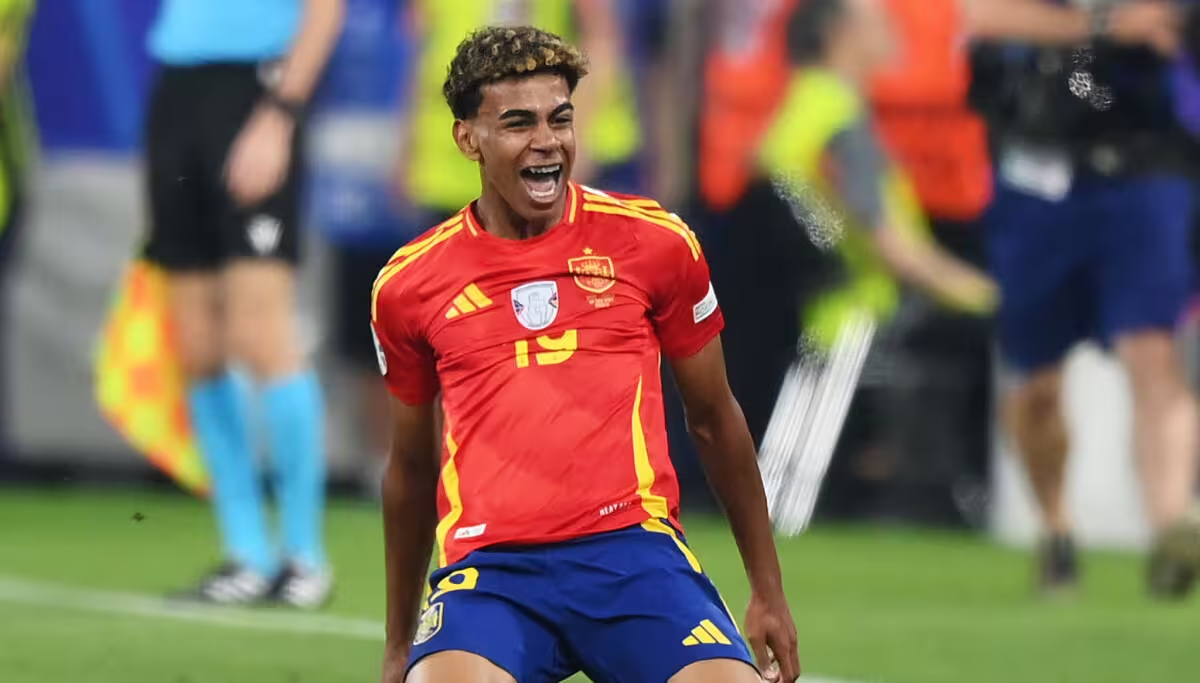

Barcelona’s appetite for entertaining playmakers is part of the context: the club’s history reads like a gallery of artists — from Diego Maradona to Ronaldinho to Lionel Messi. That heritage is the reason Leboeuf’s image of Cherki at Camp Nou landed so easily. It also helps explain why supporters and pundits alike have fastened on the possibility of a Cherki–Yamal axis as something that would feel both natural and combustible.
But the picture Leboeuf painted included friction, and he put it plainly: “Yeah. But Barcelona has some financial problems. It’s insane. They promise stuff and you see names. You say, ‘how come they could have gotten [Robert] Lewandowski and so many others?’ And you say, ‘I thought they didn't have money’. If you don't have money, I don't have money, we cannot buy anything. But they can. So good for them.” That contradiction — a club publicly flagged as constrained yet repeatedly completing headline signings — is the practical obstacle to this particular fantasy.
The contradiction is already playing out. The timeline of recent moves shows Barcelona continuing to add attacking options even as its accounts are parsed by economists and supporters. Leboeuf explicitly suggested Barcelona could sign Cherki despite those financial issues, and the club’s summer activity — including the addition of an England international in 2026 — is the behavior he referenced. For Cherki, the math is straightforward: he has a long-term deal at Manchester City, he will return to the squad under a new manager in 2026–27, and any transfer would require both clubs to agree terms that reflect those realities.
That leaves a single, sharp question hovering over Leboeuf’s claim: will Barcelona actually move to sign Cherki, and if they do, when and at what cost? Leboeuf has sketched the fit — Cherki playing as a central creator with Yamal and Raphinha providing width — but the next move belongs to Barcelona’s board, Manchester City’s willingness to sell a young creative under contract, and the numbers that both clubs will be able or willing to find.