



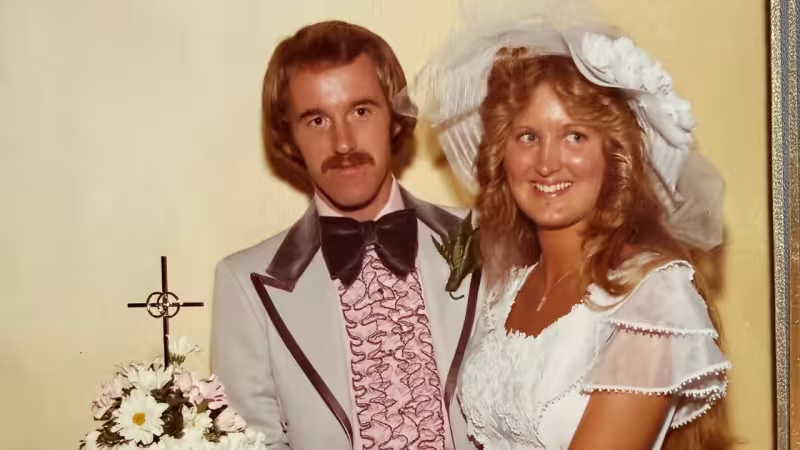
“Running is important. We want to stay young as long as we can, right,” Sandy Oliver says, and the sentence hangs in the room like a challenge and a promise.
It helps explain the wall of photos and finisher medals in the couple’s Two Harbors cabin — Camp Gramma’s Half — and why, at 72 and 71, they still lace up for Grandma’s Marathon weekends. In July the two will mark their 50th wedding anniversary; the milestone lands in the same year that has kept the race a fixture of their family life.

The numbers are simple and stubborn: five decades together, two lives threaded through a local race, children and grandchildren who run, and a handful of full Grandma’s Marathons in their past. The Olivers have shifted their focus in recent years to the half marathon, but they still sign up and travel north for race weekends, keeping the ritual intact rather than retiring it.
They did not meet on a running trail. Both attended Proctor, and their story began more formally at the University of Minnesota, where their relationship took hold. Tim remembers the early days with a laugh and a line: “She was a year younger, and very beautiful. I didn’t quite make the list in high school.” He traces his start in the sport to high school, where Garry Bjorklund was a mentor who nudged him into running — a nudge that turned into a lifelong habit.
Grandma’s Marathon is woven into the family ledger: Sandy’s brother Jack ran the first race, and that origin sits beside newer entries on the cabin wall. The couple built careers in the Twin Cities, kept the Two Harbors place for race weekends, and handed the habit down; their children and grandchildren are runners, too. The collection of medals and photos is less a tally than a map of weekends spent together and generations connected by the same start line.
There is a lighter, sharper edge to that history. Tim jokes about his pursuit: “I’ve been chasing her for 50 years, sometimes she slows down enough so think I can catch her,” he says, the line delivering both flirtation and plain fact. The chase has altered with age — the Olivers have run the full Grandma’s Marathon a few times and now concentrate more often on the half — but the competition between them is as much about togetherness as it ever was.
The shift from full to half is practical, not dramatic. Older runners often choose shorter distances to keep racing with family and friends; community events like the Bank Of America Half Marathon show how city courses fold parks and neighborhoods into manageable, multi‑generational routes. Meanwhile, marquee international races continue to make headlines — as with the recent course record at the Cape Town Marathon 2026 — but for the Olivers the point is local: the weekend, the cabin, the finish-line photo shared across generations.
They still sign up. They still keep Camp Gramma’s Half stocked with medals and snapshots. They still travel the same route to Two Harbors and unpack the same ritual. What remains unrecorded on the wall, though, is a precise ledger: how many full Grandma’s Marathons has each of them finished, and how many half marathons? That count is the clearest unanswered detail in a life otherwise marked by repetition and devotion — and it is the question that matters most if anyone wants to turn the scrapbook into a statistical record.



