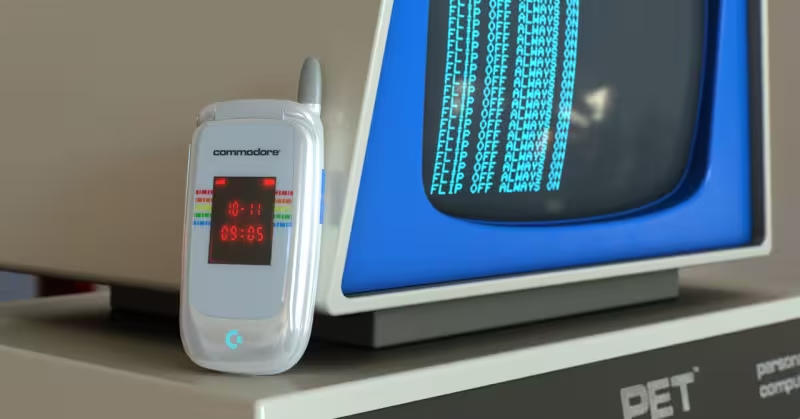
Commodore announced the Callback 8020 in 2025: a clamshell phone that runs the Linux-based Sailfish OS and, by design, blocks web browsers and social media at the system level.
The company framed the device as a deliberate retreat from endless feeds. Commodore says the Callback 8020 will still run “over 99 percent” of Android apps through Sailfish’s Android runtime, naming apps that will work — Uber, WhatsApp, Spotify, Signal — and saying internet-based tools such as maps and QR-code readers remain usable. At the same time, Commodore’s team says social platforms and standard browsers are permanently barred from whitelisting. "Social media and browsers will never get that whitelisting," Christian “Peri Fractic” Simpson said, and the company added it has patent‑pending technology to prevent those apps — and only those apps — from being sideloaded.

That contradiction is the phone’s clearest selling point and its friction point. Commodore pitches the Callback 8020 at people who want a simpler daily device without losing navigation, messaging and streaming. "A lot of people are trying to go back to slightly simpler tech and maybe trying to ditch their smartphone on the weekend," Simpson said. "We found that for the people buying the C64, that very much resonated with them. So we positioned ourselves as a bit of a digital minimalist brand." He also framed the effort as an ethics play: "where the customer is not the product."
Under the lid the Callback 8020 reads like a pocketable tech list that mixes retro flourishes with modern components. It runs Sailfish OS from Jolla, uses a MediaTek Helio G81 processor, and has a 48-megapixel Sony camera sensor. Commodore built a retro camcorder mode with procedurally generated filters, and the phone includes chiptune ringtones taken from the original Commodore 64 plus a handful of C64 games and Snake.

The hardware is unabashedly old‑meets-new: a front exterior screen shows date, time and battery status but no notifications; a dome‑shaped LED lights for messages; the main screen supports touch but is disabled by default; messaging is T9 with a predictive helper or Commodore’s voice transcription service; the battery is removable; there’s a 32‑GB microSD card included; an FM radio tuner; and a headphone jack backed by an audiophile‑grade digital‑to‑analog converter and custom in‑ear monitors from FiiO.
Commodore also leaned into personalization. The exterior screen has a red tint designed to resemble 1970s Commodore calculators, users can swap covers and attach a stringed charm, and the handset will come in five finishes: SX Silver, ProtoPET White, BASIC Beige, the translucent Starlight Edition and a PVD gold Founder's Edition whose package includes a 24‑karat gold‑plated Commodore button. The standard colors start at $500; the company did not disclose final pricing for the premium finishes.
Commodore framed the Callback 8020 as its first “unique‑feeling” phone even though it is not the brand’s first phone — the company released a branded handset in 2015 and recreated the Commodore 64 in 2025. The 8020 name nods back to an early modem: Commodore says it references the company’s 8010 modem from 1980. The device will be manufactured with a partner in Shenzhen.
Practical details matter for buyers considering a device whose chief attraction is restraint. Commodore says users can sideload nearly anything that isn’t available on the device’s store, but "we’ve drawn a firm line in the sand around any apps that drive doomscrolling," Simpson said. The company added it has also developed patent‑pending technology to prevent those specific apps from being sideloaded. That carve‑out — broad access to apps plus a hard ban on browsers and social media — will be the feature users either embrace or find contradictory.
What to watch next: Commodore says it will consult with a Callback community over the next few months to refine exactly which apps are barred and how the enforcement technology will work. Pricing for the higher‑end colorways and a concrete shipping schedule remain unanswered. If Commodore follows through, the Callback 8020 will test whether consumers will accept system‑level limits in exchange for a quieter phone that still runs the apps most people rely on.