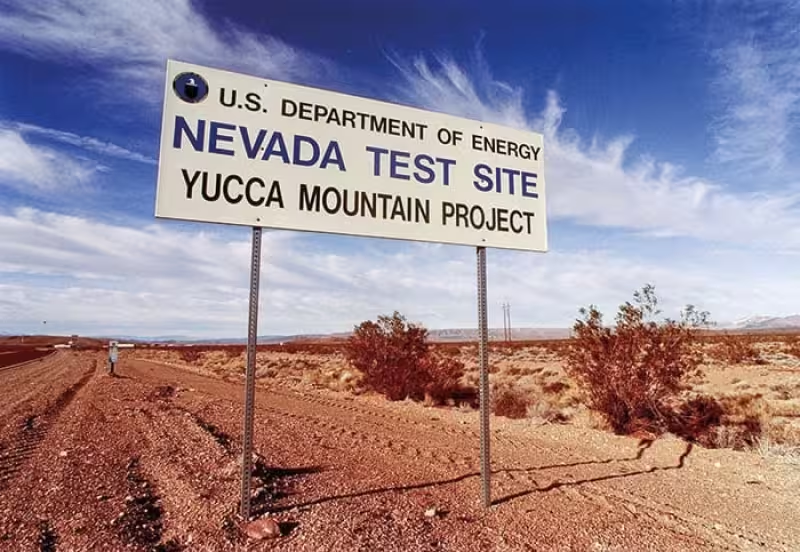
Yucca Mountain is a ridge of volcanic rock in the Nevada desert, about a hundred miles northwest of Las Vegas. For more than forty years it has been the designated answer to a question the United States still hasn't solved: what do you do with spent nuclear fuel once a reactor is done with it. The government has spent tens of billions of dollars studying, tunneling into, and arguing over this one mountain. Nothing has ever been stored there.
The waste problem it was meant to solve
Every commercial nuclear reactor in the country produces spent fuel, and none of it goes away on its own. It stays dangerously radioactive for thousands of years. Since the 1940s, this waste has piled up at reactor sites and defense facilities in dozens of states, sitting in cooling pools and, once those fill up, in steel and concrete dry casks in parking-lot-style storage yards. Today more than 70,000 metric tons of it sits scattered across roughly 77 sites, with a couple thousand more tons added every year.

None of that storage was ever meant to be permanent. Congress passed the Nuclear Waste Policy Act in 1982 specifically to get the country out of this situation, by directing the Department of Energy to find and build a deep geologic repository where the waste could be sealed away for good.
How one mountain in Nevada got picked
The 1982 law had DOE studying several candidate sites around the country. By 1987, Congress had grown impatient with the process and passed an amendment that cut the list down to one: Yucca Mountain. Every other candidate site was dropped within ninety days. Nevada, which had no senators or House members on the relevant committees at the time, had essentially no say in the decision. The amendment picked up a nickname in Nevada that stuck: the "Screw Nevada Bill." That grievance has colored the state's politics on this issue ever since, and it's a big part of why the fight never really ended.
The site itself has some real geological appeal. It sits in one of the driest parts of the continental US, on federal land next to what's now the Nevada National Security Site, ringed by an Air Force range. The rock is Topopah Spring Tuff, a dense volcanic material formed from compacted ash, and the repository design calls for tunnels roughly 1,000 feet below the surface and 1,000 feet above the water table. Engineers spent years running full-scale heat tests, using electric heaters to simulate radioactive fuel and thousands of sensors to track how the surrounding rock would respond over time.
Decades of study, then a full stop
Congress formally designated Yucca Mountain as the country's sole repository site in 2002. DOE eventually filed a license application with the Nuclear Regulatory Commission, and the review process crawled forward for years. Then, in 2010, the Obama administration moved to shut it down, withdrawing the license application and cutting off funding for construction. The administration's position was that the site simply wasn't going to work politically, whatever the science said. Nevada's congressional delegation, led for years by Senator Harry Reid, had fought the project hard, and the state has kept fighting it in court and in Congress since.



The Government Accountability Office later concluded that the project's closure came down to political decisions rather than any technical or safety finding against the site. That distinction matters to people on both sides of the debate, because it means the underlying question, whether Yucca Mountain could safely hold the waste, was never actually answered one way or the other. The NRC did complete significant portions of its technical safety review before the process stalled, but it never issued a final licensing decision.
Since then, the project has existed in a kind of limbo. Congress still allocates a small amount of money each year, in the range of $12 to $13 million, but it goes toward site security, data preservation, and legal costs rather than construction. Meanwhile, nuclear utilities and their customers have paid more than $40 billion into the federal Nuclear Waste Fund over the decades, money that was collected specifically to pay for a repository that still doesn't exist.
What the arguments actually are
Supporters of building the repository point to the basic math: the waste already exists, it isn't going anywhere on its own, and consolidating it in one well-studied, sparsely populated location is safer than leaving it scattered at more than seventy sites near population centers and waterways around the country. They also note how much has already been invested in understanding this specific site, and argue that starting over somewhere else would waste decades of research.
Opponents, including Nevada's state government, raise a mix of technical and practical objections. They point to seismic and volcanic activity in the region, question whether the rock and engineered waste containers would hold up over the tens of thousands of years the waste stays dangerous, and note that the site sits near an aquifer that feeds agricultural land in the Amargosa Valley. They also raise the transportation problem: moving waste to Yucca Mountain would mean thousands of shipments by truck and rail through hundreds of counties across dozens of states, each one a potential accident or security risk along the way. And even at full legal capacity, the repository was designed to hold about 70,000 metric tons, a figure that would already be roughly matched by the waste sitting in temporary storage today, before accounting for future waste generation.
There's also the fairness argument Nevada has made from the start: the site was chosen by a Congress that overrode the objections of the one state that would have to live with it.
Where things stand now
As of 2026, Yucca Mountain remains what it's been for well over a decade: a fully studied, partially reviewed, unbuilt project. No waste has been shipped there, no construction has resumed, and no administration since Obama's has managed to restart the licensing process in any lasting way, despite periodic proposals to revive it. Renewed political interest in expanding nuclear power as an electricity source has kept the broader waste-storage question in the news, but that hasn't translated into new movement on this specific site.
In the meantime, the waste keeps accumulating exactly where it already is, at reactor sites across the country, in storage that was never meant to be a permanent solution. Whether Yucca Mountain eventually reopens as a live project, gets replaced by an entirely different approach such as interim storage facilities or newer disposal methods, or simply stays frozen in place indefinitely is still an open question. It has been for a long time, and nothing currently on the table suggests that's about to change soon.