



How many substitutions are allowed in the World Cup? For roster replacements caused by injury or illness in the 2026 tournament, the answer is short and strict: outfield players can be replaced only before a team’s first match — no later than 24 hours beforehand — while goalkeepers can be replaced at any point during the tournament.
The timing matters now because final squads for the 2026 World Cup were locked in during early June and a stream of injuries has already thinned several teams. Preliminary lists of 35 to 55 players, submitted by May 11, were the only pool from which an injured outfield replacement can be drawn; final squads of 23 to 26 players were due by June 1 and were publicly released on June 2 ahead of the June 11 opener.

The mechanics are straightforward. A team seeking to swap an injured outfield player must submit the replacement at least 24 hours before its first tournament match. The incoming player must be named on the preliminary list. FIFA’s Medical Committee requires a written medical assessment confirming the injury or illness is severe enough to rule the player out of the entire tournament before the change is approved.
Once a team makes that permitted swap it is permanent: the injured player is out for the rest of the World Cup and the replacement inherits the injured player’s jersey number for the duration. That permanence pushes national selectors into conservative decisions when finalizing rosters because a last-minute replacement extinguishes any chance of the original player returning.
The single big exception is goalkeepers. Teams must carry at least three goalkeepers on their final roster and include at least four goalkeepers on the preliminary list, but if a goalkeeper is injured during the tournament he may be replaced at any moment. That replacement does not even have to come from the original preliminary list — a latitude not extended to outfield players.


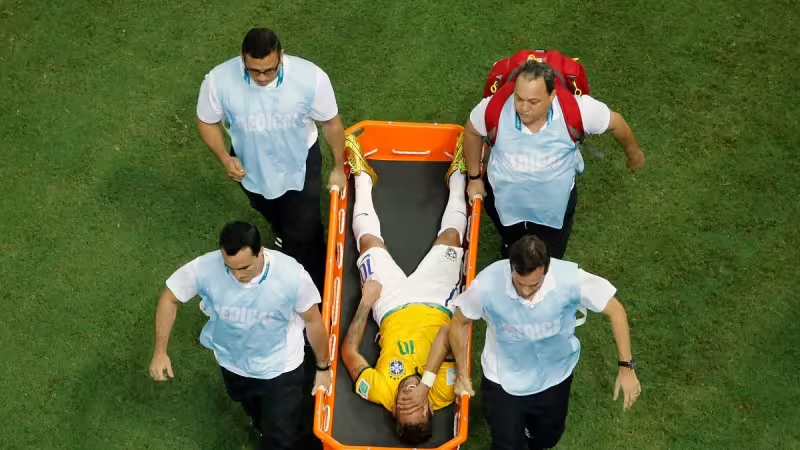
Those different rules have historical bite. In 2014 Brazil lost Neymar to a fractured vertebra after the quarterfinal with Colombia and could not replace him; Brazil rolled into the infamous 7-1 semifinal defeat to Germany without their star. In 1970 England’s Gordon Banks fell ill the day before a quarterfinal in Mexico and Chelsea’s Peter Bonetti was rushed in with little more than an hour’s notice; Bonetti’s errors contributed to West Germany clawing back from a two-goal deficit.
Practical consequences are immediate. Teams with doubts over players such as Rodrygo, or hopefuls like Mo Salah and Lamine Yamal racing to regain fitness, must weight the risk of naming them in a final squad against the inability to bring an outfield replacement after the 24-hour cutoff. Medical evidence and tight timelines will determine who travels and who is left off.
The friction is plain: goalkeepers enjoy unrestricted mid-tournament replacement while injured field players do not — a rule that shapes not only who appears on the pitch but how federations construct their squads and contingency plans before kickoff.
The one conspicuous gap for coaches and fans is the tournament’s in-match substitution policy; the roster-replacement rules explain how squads are fixed but do not state how many substitutions will be permitted during matches. That omission leaves a practical, immediate question unanswered at the moment teams are finalizing tactics and bench roles going into the 2026 World Cup.
Teams now must make irreversible calls under the 24-hour rule: replace an injured outfielder before the deadline or lock in a squad that might be short-handed. The goalkeeper exception remains a safety valve — and the unresolved detail about in-match substitution limits is the next information teams and supporters need to settle how those squads will actually be used on the field.



