



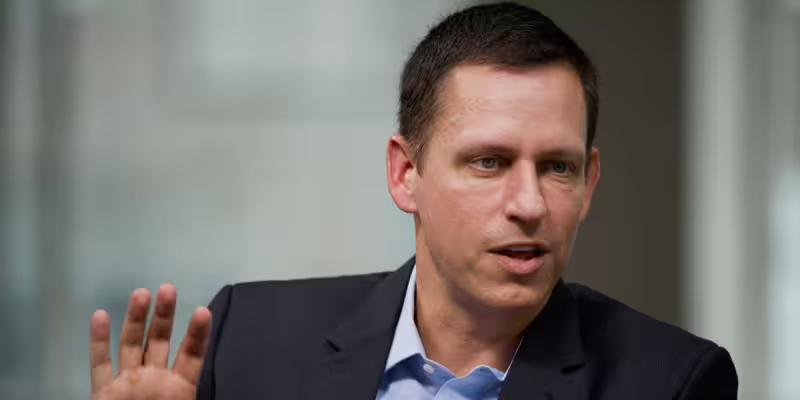
Peter Thiel temporarily relocated to Argentina last week while pursuing additional residence and citizenship options, a move the ultrawealthy increasingly treat as buying a literal and legal fallback — a passport that is more insurance than tourism. Thiel, who holds citizenship in the United States and New Zealand, has reportedly applied for a Maltese passport as part of that portfolio of options.
The shift is measurable. A 2025 UBS survey of 87 billionaire clients found 36% had relocated at least once and 9% were considering it. In 2025 Henley and Partners recorded a 99% year‑over‑year increase in applications from Americans interested in alternative residence and citizenship, and an April 2026 report from Altrata concluded billionaires and centimillionaires no longer rely on a single system, market, or passport. Charlie Garcia, who advises wealthy clients, captured the mood plainly: "It sounds melodramatic until you've sat through the off‑the‑record dinner conversations: nuclear escalation, AI going sideways, and generalized civil unrest in the Northern Hemisphere."

For wealthy Americans, the calculus is practical rather than purely political. Second passports and residency programs are expensive insurance: "A contingency plan is quite expensive," Basil Mohr‑Elzeki said. Tax avoidance is less central for many: U.S. citizens remain liable for U.S. taxes in many cases, so the lure is safety, mobility and redundancy — the ability to show up somewhere else with paperwork and a place to stay if global shocks make that necessary. Americans have overtaken previous markets as the dominant clients for second‑passport services, and Europe remains the most popular destination.
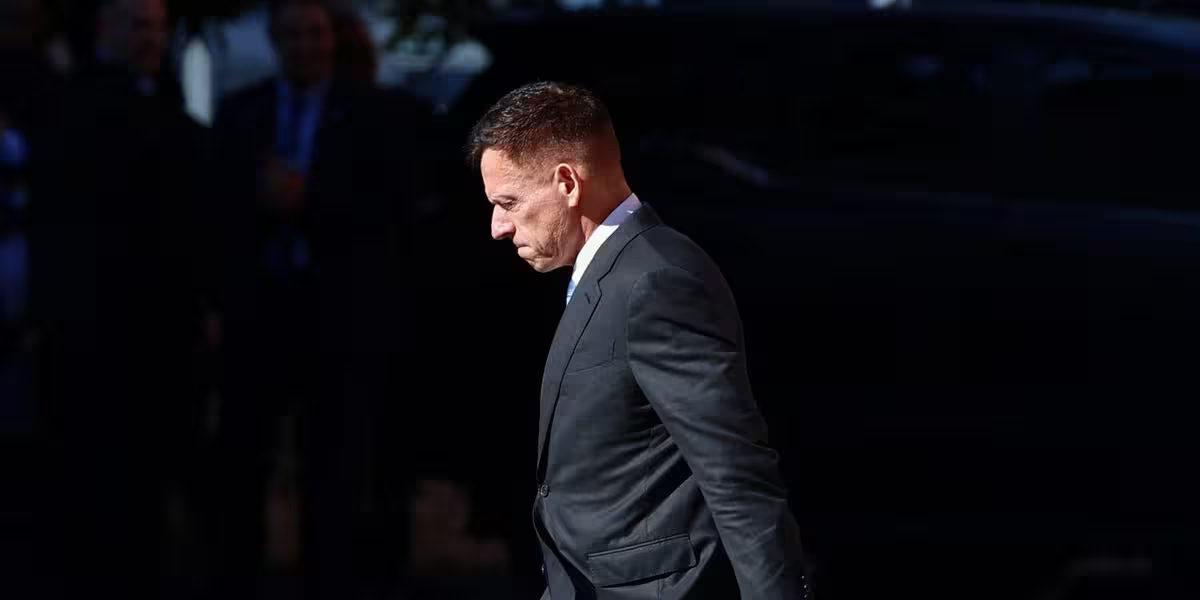

That practicalism helps explain why Thiel’s stop in Argentina made headlines. Argentina now has a new president, Javier Milei, and some ultrawealthy clients view parts of the Southern Cone as a geographically distant refuge. "For that crowd, the Southern Cone looks like a literal and figurative safe distance," Garcia said. Yet the country’s appeal is complicated: wealth and relocation advisors warn Argentina’s economy remains volatile and there are "few straightforward paths to citizenship and permanent residence in Argentina that do not involve relocation," meaning temporary stays do not easily translate into long‑term legal guarantees.
The friction is clear in the marketplace. Advisors who move billionaires through application forms and real‑estate deals say the programs that scale — the EU routes, Malta, Portugal and other European options — are typically smoother and better understood. Thiel’s reported application for a Maltese passport fits that pattern: Europe offers structured, legal pathways that pair residency with predictable rights. At the same time, the spectacle of a billionaire landing in Buenos Aires underscores how backup plans can be idiosyncratic; Winston Chesterfield, another adviser, described the behavior this way: "He does do this sort of thing all the time," and, more bluntly, "He goes around buying different places, different plan Bs all over the place."
Those plan Bs carry real cost and consequence. Wealth managers warn contingency programs can run into eight figures when they include property, legal teams and multiple residency applications. They also face political risks at both ends: destination countries may tighten rules, and sending large sums or visible people into a market can provoke backlash — "People saying billionaires shouldn't exist," Chesterfield noted — that changes the calculus overnight. Domestic policy moves complicate matters further; for some Americans, measures such as a child support crackdown that now includes passport cancellations for large debt have reinforced the appeal of having options abroad.
What remains unresolved is whether Thiel will convert the visit into long‑term residence or citizenship, obtain the Maltese passport he reportedly applied for, or simply continue adding options elsewhere. The only firm conclusion is that backup‑country planning is now a mainstream, costly strategy among the ultrawealthy: they are buying mobility in a world they regard as less predictable. The next consequential fact will be whether Thiel or others move from temporary stays to formal, durable legal ties — or whether volatility in places like Argentina proves too high a price for peace of mind.



