The Bureau of Labor Statistics will release the May Consumer Price Index at 8:30 a.m. ET Wednesday, and economists surveyed by Dow Jones expect the annual inflation rate to rise to 4.2% — a level above the 2.4% seen before the war and the highest since early 2023.
If the forecast holds, May would mark a third straight month of rising inflation, reviving market and policymaker concern that recent energy-driven price moves are broadening into the wider economy.

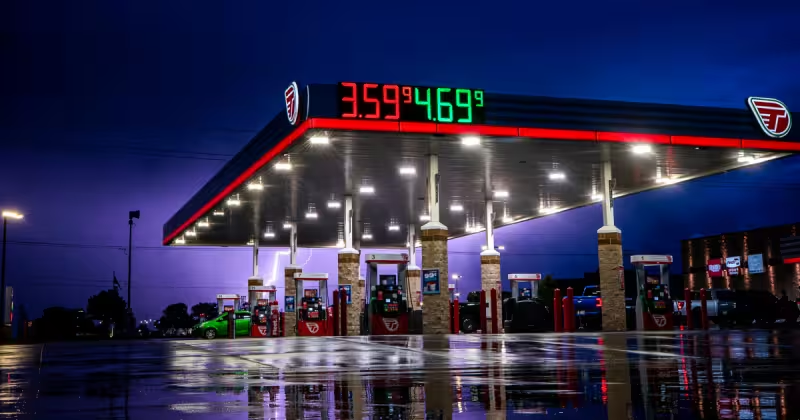
Energy is the obvious driver: since the war with Iran began, oil prices have climbed nearly 40% and U.S. crude briefly topped $115 per barrel in early April. Retail gasoline has eased by about 40 cents from its peak this year, but consumers still pay roughly 40% more at the pump than before the conflict. Those shifts alone could account for a meaningful slice of the expected lift in headline inflation for May.
Core inflation, which strips out food and energy, is expected to return close to 3% in the report — a key read for markets and the Federal Reserve because it signals whether energy costs are spilling into services and goods prices. Bank of America analysts say that, beyond higher airfares, there is little evidence so far that overall inflation has bled into core measures; at the same time they warn numerous indicators point to pass-through occurring soon, raising the risk of a repeat of the 2022 pattern.
Those competing signals matter for policy. Traders currently put the odds of a Federal Reserve rate hike by October at about 60%, and expect a hike by December. If May’s CPI shows core inflation firming, markets could move up the timetable for tighter policy; if the rise is narrowly confined to energy, the Fed might view the move as more transitory.


Other potential price pressures are also in play. Proposed tariffs from the White House have re-entered the debate over inflation: a JPMorgan economist noted that tariffs have “elbowed their way back into the headlines,” reflecting the risk that duties could push up import prices if finalized. The tariff proposals remain draft and contain dozens of exceptions, but they add another layer of uncertainty to the inflation outlook.
The labor market is another piece of the picture. The U.S. added 172,000 jobs in May, data that some economists say shows little to criticize and that could reinforce Fed confidence that employment has stabilized even as price pressures pick up.
Energy traders and some analysts say the near-term risk remains tilted toward higher prices: observers have warned that stockpiles could hit critically low levels by the end of June, a development one industry participant warned could make prices “shoot up.” That scenario would make it more likely that headline gains bleed into core categories on future readings.
The key unknown the CPI report cannot fully resolve is how much of the expected 4.2% increase stems from energy versus broader, economy-wide price pressures. The May figures will show the split between headline and core moves, but the decisive test will be whether core inflation accelerates in subsequent months — and whether indicators Bank of America flagged as warning signs begin to materialize.
The Bureau of Labor Statistics publishes the May CPI at 8:30 a.m. ET Wednesday; markets will parse the headline, the core reading and the sector breakdowns for signals on whether higher energy costs are merely a one-off hit or the start of renewed, generalized inflation that could prompt earlier Fed action.