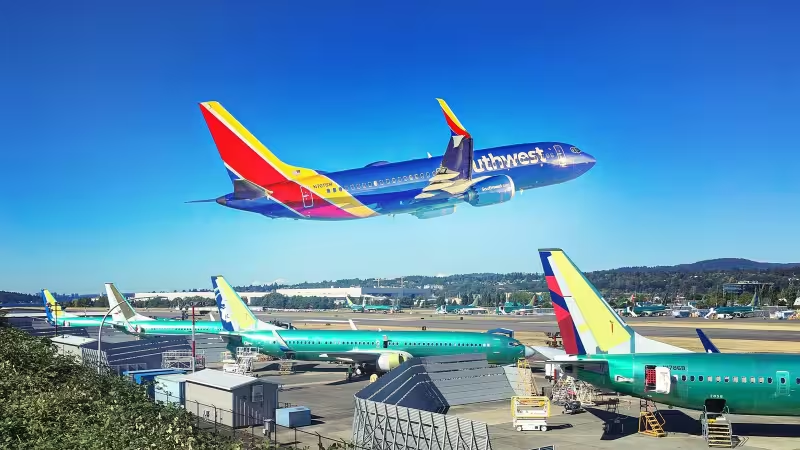
Boeing withdrew its request for a Federal Aviation Administration exemption for the 737 MAX 7 and 737 MAX 10 after the January 2024 Alaska Airlines 737 MAX 9 door plug blowout put fresh pressure on the company’s safety record and certification process. The move leaves Southwest Airlines with more than 300 MAX 7 orders still stranded and keeps the larger MAX 10 stuck in a separate approval fight.
The issue turns on the CFM LEAP-1B engines used across the 737 MAX family. Engineers found that, under certain dry conditions, prolonged use of the engine anti-ice system could overheat the carbon-composite inlet structure, especially in warm air around 50 degrees Fahrenheit and between 20,000 and 30,000 feet. Boeing tried to keep the plan moving by seeking a time-limited exemption while it worked on a permanent redesign, arguing the risky conditions were uncommon and manageable in the cockpit.

That argument did not carry the day. In August 2023, the FAA issued an Airworthiness Directive that set operational limits tied to the anti-ice system, and crews flying the MAX 8 and MAX 9 have since been required to switch the system off after five minutes in dry air when icing is not actually present. Some crews have relied on post-it notes in the cockpit to remember the step, a small sign of how a technical fix has spilled into daily operations.
The friction for Boeing is that the workaround is already affecting aircraft in service while the certification clock keeps running on the next two MAX variants. The MAX 10, which has an order book of more than 1,400 aircraft, has not entered commercial service and remains in FAA review. Carriers counting on it for fleet renewal and added capacity do not have a firm delivery timeline, and the delay gives Airbus more time to press its A321neo advantage in the same market.
Boeing’s withdrawal after the Alaska Airlines blowout did not settle the underlying question: whether the FAA will clear the MAX 7 and MAX 10 under the current design path or demand more changes first. The 737 MAX fleet was grounded for 20 months after earlier safety issues, and regulators have shown they are not willing to move quickly just to match Boeing’s schedule. For Southwest and other carriers, the answer still matters because the planes they ordered are not arriving until the certification dispute is resolved.