



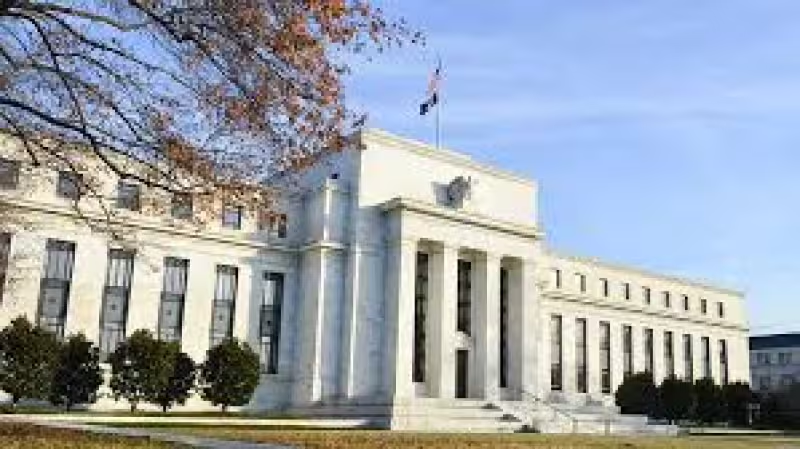
The Dow Jones Industrial Average rose 0.6% to a new record on Tuesday as investors shifted attention to the Federal Reserve's June meeting, which began the same day and will produce the first rate decision under Chairman Kevin Warsh on Wednesday.
Wall Street was mixed: the S&P 500 fell 0.6% and the Nasdaq Composite dropped 1.1%, while the Dow’s gain marked a fresh high after markets cheered a peace deal between the US and Iran on Monday. The session’s breadth underscored a narrow leadership pattern—big, cyclical industrial names helped lift the Dow even as growth and tech benchmarks lagged.

Individual stocks supplied much of the session’s action. SpaceX shares rose for a third day after the company’s public debut last week, climbing about 8% in afternoon trading and briefly surpassing Amazon in market value earlier in the session; SpaceX reached a valuation of $2.74 trillion. Western Digital jumped 7% after a Monday surge of 16% when Morgan Stanley raised its price target to $650 from $488 and maintained an Overweight rating; Western Digital had been among thirty S&P 500 stocks that closed at record highs on Monday. At the same time, memory and chip names Micron, Sandisk and AMD retreated from all-time highs on Tuesday.
Federal Reserve policymakers opened their June meeting with an expectation widely shared on Wall Street that rates would be held steady at this gathering. Many investors, however, were focused on the Fed’s dot plot—the confidential calendar of officials’ rate expectations—where a shift toward more hikes this year is widely anticipated but not yet certain. Warsh’s first decision and any accompanying guidance on the outlook for policy would be parsed for changes in that projection on Wednesday.


Markets are reacting to two competing forces as the Fed meets: relief around a tentative peace agreement between the US and Iran and renewed uncertainty about global supply routes. US officials said the Strait of Hormuz would reopen to commercial traffic without tolls by Friday, with the president declaring, "The strait is already partially opened," and adding that "ships are starting to move." A senior US official told reporters the reopening should occur "definitely within 30 days."
Shipping analysts, however, questioned whether normal traffic would resume quickly or durably, and that skepticism undercuts any immediate assurance that energy and shipping risks—factors that pushed inflation reports hotter amid the conflict—are resolved. The contrast between official timelines and industry caution creates a live economic risk the Fed must weigh alongside domestic price readings and global central-bank moves such as the Bank of Japan’s rate rise earlier on Tuesday.
For investors, the immediate implication is a market that can set records even as narrow leadership concentrates gains and macro risks persist. The Dow’s new high owed as much to a handful of strength cases—industrial and value-oriented names plus a few blockbuster listings—as to broad market momentum; the S&P and Nasdaq’s declines show how fragile that advance can be if the Fed signals a tighter path for policy or if shipping disruptions push energy and goods costs higher again.
What happens next is clear on the calendar: the Fed will announce its decision on Wednesday, and markets will use the statement and the updated dot plot to reassess the odds of further hikes this year. The dot plot’s direction is the single unresolved market question: a move toward more hikes would likely widen the divergence between the Dow and the other major indexes and could reverse the session’s gains; a steady or dovish signal would reinforce Tuesday’s record for the Dow and reduce near-term volatility.



