



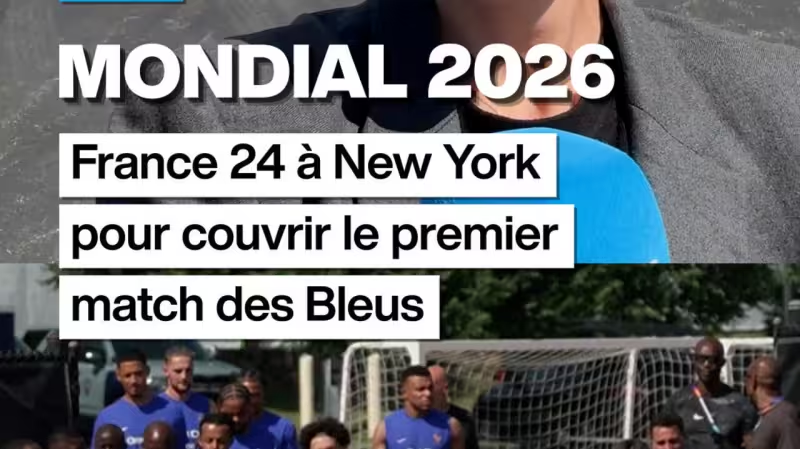
On 16 June 2026 France 24 dispatched special correspondents to New York to cover France’s opening match of the 2026 World Cup against Senegal.
The network published its dispatch at 11:39 ET and pushed an updated version at 15:19 ET the same day, underlining that France’s campaign begins with a high-profile fixture on U.S. soil. The story highlights France’s attacking trio — Mbappé, Dembélé and Olise — as the front line expected to carry the team forward in the tournament’s opening stages.

Having sent reporters across the Atlantic, France 24 is treating the fixture as more than a first match on the schedule: it is a story about a major football nation starting its World Cup in a global media capital. The deployment puts correspondents where many viewers expect live reaction, analysis and interviews to happen in real time.
For audiences trying to follow that on-site coverage, there is a practical hitch: the video component embedded in the network’s coverage is not playing without browser-side intervention. Viewers who do not authorize cookies will see the player remain inactive, and users with certain browser extension blockers report the video failing to load until the extension is disabled. That digital snag complicates access to the same footage the reporters filed from New York.



The match itself is framed as France versus Senegal — the official opener for France’s 2026 campaign — and the presence of a dedicated team in New York signals international attention on the pairing. The on-the-ground dispatch emphasizes the attacking configuration but does not supply a venue or kickoff time for the game in New York, leaving a basic logistical detail unaddressed in the report.
That omission matters. Sending a crew to New York commits resources and creates expectation that audiences worldwide can watch or at least tune into live reporting. Without a listed stadium or kick-off time, viewers and local fans lack the immediate practical information that usually accompanies a live international deployment. The gap between on-site presence and missing match logistics is the story’s most concrete friction.
For readers planning to follow France’s opener, the essential facts remain: France begins its World Cup against Senegal, and correspondents are reporting from New York. The attack pairing of Mbappé, Dembélé and Olise is the named frontline to watch, and the network has signaled it will cover buildup, reaction and post-match analysis from the scene.
What to watch when the game begins is straightforward in sporting terms: whether France’s attacking trio can dominate a Senegal side that has previously challenged top opponents. In practical terms, how viewers will watch France 24’s on-site video is less clear until the cookie prompt or any blocking extensions are resolved. The technical hurdle could shape how widely the live clips and interviews circulate in the tournament’s opening hours.
France 24’s presence in New York shows this is a fixture attracting immediate international media attention, but the report leaves the most consequential detail unresolved: where in New York the match will be played — and, as importantly for audiences, how they will reliably access the network’s video coverage given the player’s cookie and extension constraints.



