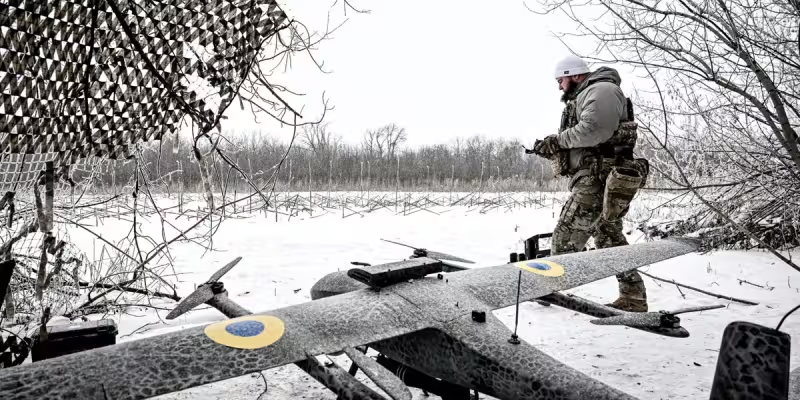
Ukraine's newest winged attack drones have begun regularly striking Russian rear areas, and their use has risen in the last two months as Moscow has lost more ground than it has gained.
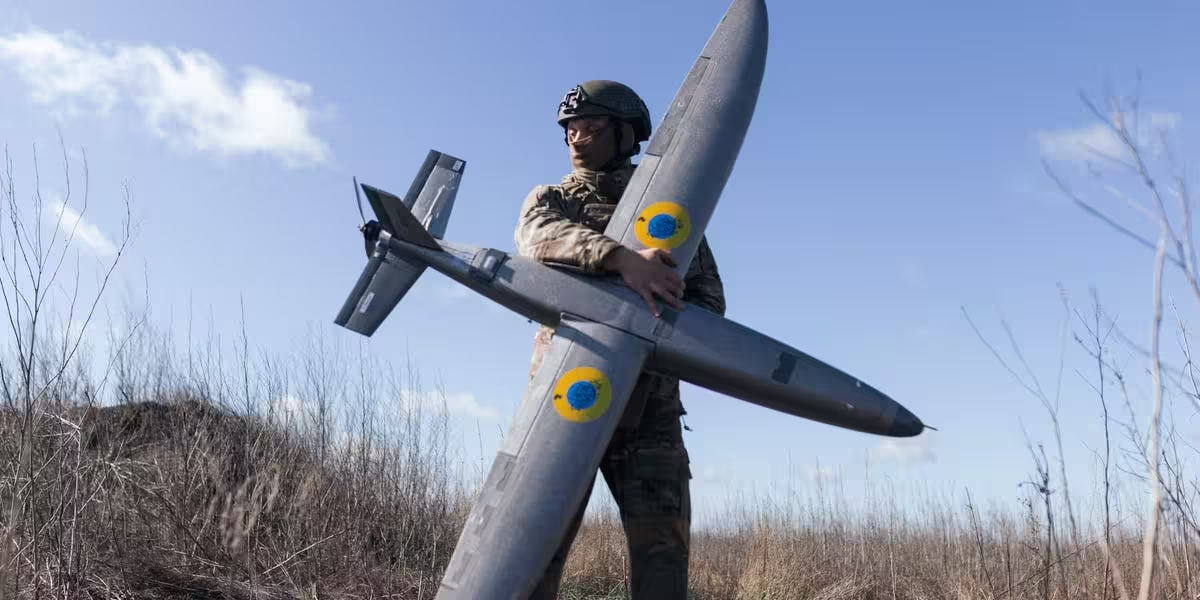
These systems sit between small loitering munitions and long-range missiles: cheaper, medium-range drones that can travel roughly 30 to 300 km and, in some cases, carry heavier explosive payloads built to devastate command posts, supply trucks and air defense assets. Some models also include artificial intelligence systems that will autonomously lock onto a target if they lose the pilot's signal, extending effective reach even when forward targeting support is limited.

That capability matters because Kyiv's deep-strike options early in the war were dominated by donor systems. Roughly 40 US-made HIMARS launchers gave Ukrainian forces rockets out to about 150 kilometers and, with longer-range missiles, nearly 300 kilometers; British-French Storm Shadow missiles similarly let Kyiv hit headquarters, rally points and supply depots. Those strikes were decisive at first, but Russia adapted after the first year and curtailed the HIMARS threat; the new drones are providing a lower-cost, more autonomous way to press the same kinds of rear-area effects.
Footage reviewed by analysts of a mid-2025 strike shows one of those drones approaching from roughly three thousand feet to hit a house in rear-area territory. Spring, a pilot with the Ukrainian National Guard's Typhoon unit who said the strike was her first successful strike, described the target: "This was a house where Russian FPV drone pilots lived," she said — a textbook rear-area aim that removes local launch capacity as well as personnel.

Analysts argue the strikes are already changing the battlefield calculus. "We argue that the Ukrainian mid-range strike is actually heralding a new phase of the war," George Barros said, and added that, "What we're looking at here is a really solid foundation for Ukraine to blunt Russian advances." In practical terms, that foundation shows up as more consistent interdiction of logistics and command nodes in sectors where conventional Western firepower is scarce or politically constrained.
But the advantage carries a familiar friction. Russia's initial adaptations against HIMARS — dispersal, concealment, and electronic measures — show the path Moscow can use again. Gil Barndollar cautioned: "In some sectors of the front, they appear to be having a meaningful impact on Russian logistics, which steadily affects front-line forces and makes even the piecemeal Russian infiltration tactics less viable," implying that where drones matter most they are already inflicting cumulative damage. At the same time, Russia has a record of developing countermeasures; electronic jamming and targeted air defenses could blunt the drones the way other adaptations blunted rockets and missiles after the first year.
The operational consequence is immediate: Ukraine can now hit a wider spread of rear targets at lower cost and with greater autonomy than early-war dependence on donor targeting allowed. That reduces Kyiv's need to route every deep strike through foreign-controlled fire systems and widens options for commanders facing local Russian buildups. "We're actually quite bullish on the prospects for Ukraine having some substantial upper-hand momentum as we go into the summer," George Barros said, signaling analysts' expectation that the strikes could shape operations in the near term.
The central unanswered question is how durable this edge will be. The drones restore a form of independent mid-range strike capacity, but whether that capacity endures depends on how rapidly and effectively Russia can deploy countermeasures — electronic warfare, new air defenses or tactical changes — to deny the same rear-area targets. That contest over adaptation, not merely production, will determine whether Ukraine's mid-range drone strikes remain a lasting shift or a temporary tactical window.