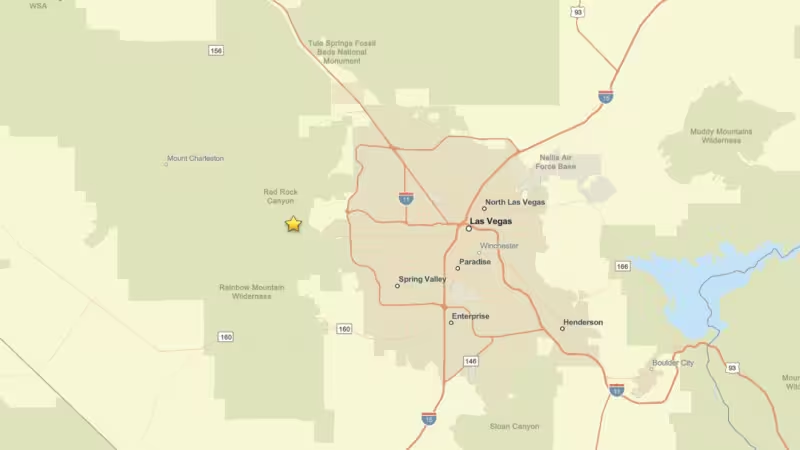
A 3.8-magnitude earthquake rattled communities west of Las Vegas on Thursday afternoon, the U.S. Geological Survey reported, with the initial jolt recorded about 1:47 p.m. roughly seven miles west of Summerlin in the Red Rock Canyon area.
The USGS said the quake’s first automatic reading registered at 4.1 before analysts revised the magnitude downward to 3.8. Shaking from the event was reported as far west as Pahrump, though there were no immediate reports of damage after the tremor.

Among earthquakes today, this one drew attention because of its breadth: residents across the western edge of the Las Vegas Valley and beyond felt the movement. The agency published a short-term forecast that places a 33% chance of at least one aftershock measuring 3.0 or greater occurring within the next week.
The recorded epicenter in the Red Rock Canyon area sits on the western flank of the valley that contains Summerlin, a largely residential zone. That geography helps explain why a quake under 4.0 registered over a broad area; local residents and businesses reported feeling the shaking even where seismic intensity is typically lower.
There were no immediate reports of injuries or structural damage in the minutes and hours after the event. Emergency services and local officials had not issued bulletins of damage as of the first reports, leaving the human and material impact largely limited to accounts of felt shaking.
The USGS’s initial automated feeds briefly showed a second, smaller event — a 3.1-magnitude quake listed north of Mesquite, Nevada — but that separate entry was later removed from the agency’s website. The reversal underscores how preliminary seismic readings can change quickly as analysts reprocess data.
Real-time seismology produces quick automated estimates to alert the public, and those early numbers are often updated. In this case the larger event’s magnitude was adjusted downward from 4.1 to 3.8, and the Mesquite reading that appeared briefly on the public map did not survive later review and was taken off the site.
The most immediate practical consequence for residents is the USGS aftershock probability. A 33% chance of a 3.0-plus aftershock in the next seven days does not mean one will occur, but it does set an expectation for possible additional shaking; aftershocks of that size can be felt but are unlikely to cause widespread damage following a 3.8 mainshock.
What remains unresolved is whether any aftershock will register at 3.0 or higher and whether subsequent shaking will produce any delayed reports of damage. The USGS forecast is the clearest next development to watch: it quantifies the short-term risk and will be updated as new seismic data arrive.
For now, the event stands as the principal seismic activity in the region for the day: a moderate quake centered near Red Rock Canyon that was widely felt but left no immediate, confirmed damage, coupled with the brief appearance and removal of a separate Mesquite report that highlights the provisional nature of early quake data.