



John wept when officials told him the campaign he had led had succeeded: his father’s name would be added to the British Normandy Memorial. "I was really pleased, I cried," he said. "It's a strange mixture of being glad and happy and sad at the same time." He had gone to Normandy for the 82nd anniversary of D-Day to see that stone given its new line of text.
The moment came on 6 June 2026 as officials unveiled 98 additional names above Gold Beach — men found by fresh research or identified after families supplied evidence that a relative had been killed in Normandy. The new inscriptions also acknowledge cases like Cecil Green, who was mortally wounded in Normandy but was not formally commemorated because he later died in a British hospital.

Those 98 new entries give the ceremony a particular weight: the memorial has expanded even as the number of surviving men who were there has dwindled. Only six Normandy veterans are confirmed to be attending this year’s commemoration, the smallest gathering since the British Normandy Memorial opened in 2021. The contrast — a growing roster of the dead and a shrinking circle of living witnesses — was visible in faces around the stone.
At the memorial, Kenneth Hay put the change into plain language. "To most people coming here they're just a series of names," he said. "To people like myself, they're people, I can see their faces." That view has driven families and researchers back into archives and hospital records; the discoveries forced organisers to return to the walls and add the men who had been left off because wartime records were inaccurate or because deaths in Britain after evacuation were overlooked.
John’s father's inscription was one of the 98 added on the anniversary; for him the stone closed a gap that had been personal and public at once. For others the additions are a reminder that the official lists created in the years after 1944 were incomplete. Families who regained a name on the wall described relief, while historians are left asking whether more omissions remain.


The commemorations themselves began on the morning of the anniversary with French schoolchildren walking across Juno Beach to mark H-Hour. Serving military personnel, the grandson of British Commander Field Marshal Montgomery and pipers from the Jedburgh Pipe Band marched with the children — a ceremonial cross-generational link to the men who landed on the beaches on 6 June 1944.
D-Day was the largest military seaborne operation ever attempted: British, American and Canadian troops landed simultaneously on five separate beaches in Normandy to begin the campaign to liberate Nazi-occupied north-west Europe. The invasion, originally set to start on 5 June, had been delayed 24 hours because of storms.
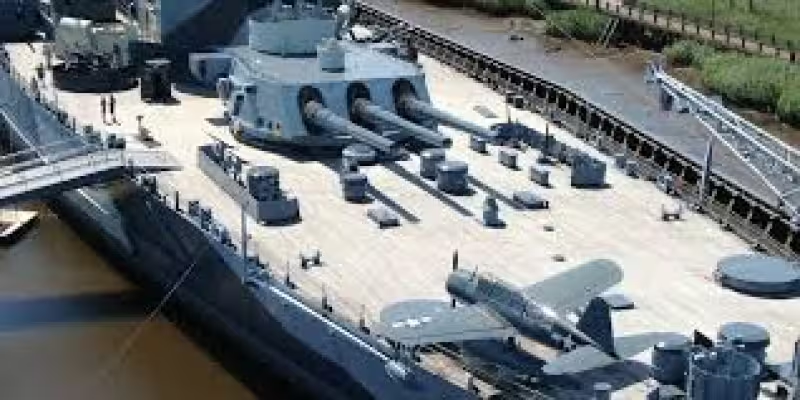
Across the Atlantic, Battleship North Carolina will be illuminated beginning at sunset on Saturday, June 6, in a separate act of remembrance. "The anniversary of D-Day gives us an opportunity to reflect on the immense courage required of those who crossed the English Channel and stormed the beaches of Normandy," said Dr. Jay C. Martin. "Their actions helped secure the freedoms we enjoy today." He added: "By illuminating the Battleship North Carolina, we honor their service and reaffirm our responsibility to preserve and share the stories of the World War II generation." The lights will be visible from downtown Wilmington and the surrounding waterfront.
The ceremony’s smaller veteran turnout sharpened an awkward truth at the memorial: carved names can increase even as direct testimony vanishes. New panels return identities to stone — but they also underscore how few people remain who can speak in the first person about what it was like on those beaches.
Commemorative events continue through the week, and organisers say no further additions to the memorial were confirmed on the anniversary. The unanswered question now hangs plainly: as researchers keep working through records and families submit evidence, how many more men who fought and died in Normandy still do not appear on the walls?



