



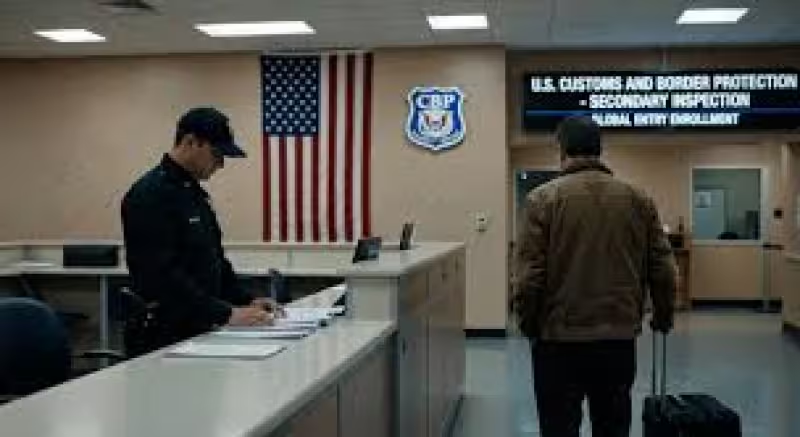
A U.S. visa holder arriving at Los Angeles airport after a prior visit to the United States was denied entry and taken into U.S. Customs and Border Protection custody, the account of the incident shows.
The detention left his family unable to contact him at the time the report was filed. Authorities held the traveler in CBP custody following the denial of entry; details about the reason for that denial have not been disclosed.

The record available notes only that the denial followed a previous visit to the United States. No further information has been provided about what occurred during that earlier trip, what triggered scrutiny on arrival, or whether documentation or visas were examined or challenged at the port of entry.
The family’s inability to reach him while he remained in U.S. Customs and Border Protection custody is the sharpest fact in a sparse account. That gap — a person detained inside a federal agency’s custody with relatives unable to make contact — frames the immediate human consequence of the decision to refuse entry.



Public reporting of the episode contains no statement from CBP, no explanation of the legal basis for the denial, and no timeline for how long the traveler remained in custody. The only concrete items on record are the denial of entry at the Los Angeles airport after a prior visit, detention by U.S. Customs and Border Protection, and the family’s inability to contact him.
For now the central unanswered question is specific: what about the previous visit prompted the denial on arrival this time? That is the single fact that, if answered, would change the shape of the event from an unexplained detention into a comprehensible enforcement action.
The moment remains unresolved. The traveler is the immediate party affected, and his family’s lack of contact is the human consequence that follows from the agency action. Absent additional detail about the prior visit or the grounds for refusal, the case stands as an unelaborated denial of entry and custody event at a major U.S. airport.
The record ends on that open fact rather than on closure: the denial and the custody are confirmed, and the family could not reach him; what specifically triggered the denial during or after the previous visit is the consequential omission that must be filled to understand why the detention occurred.



