



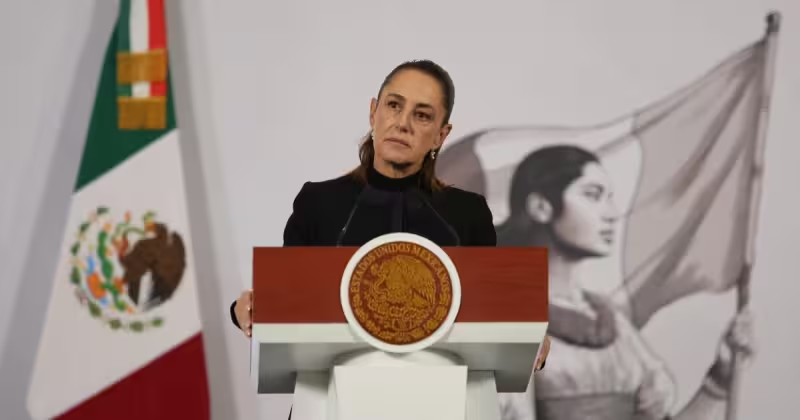
Claudia Sheinbaum, president of Mexico, on Wednesday accused the United States of meddling in Mexico’s internal affairs after a report said the U.S. had revoked visas for two governors from her Morena party amid criminal investigations.
Speaking at her daily news conference, Sheinbaum said the government would not accept outside pressure and demanded to know the U.S. rationale. "What is the intent behind revoking the visas, and, furthermore, making that information public?" she asked, adding: "What is the underlying motive?"

The report named Alfonso Durazo of Sonora and Américo Villarreal Anaya of Tamaulipas as the governors whose visas were said to have been cancelled amid probes into possible links to organized crime. The report’s sources also said both men later received Significant Public Benefit parole.
Durazo rejected the characterization on Wednesday, saying his visa had not been revoked and that he was unaware of any investigation into his actions. "I practically sweat holy water," he said, blaming the report on "a deliberate effort to politically undermine a progressive project." Villarreal denied any connection to organized crime and, in a statement, said "as a public servant, I have always been transparent, responsible and followed the law."
The immediate consequence of Sheinbaum’s remarks is a fresh diplomatic strain with Washington. Sheinbaum framed the visa action as an attempt to pressure Mexico’s institutions, saying, "When those abroad dictate who is guilty and who is not, when there are attempts to pressure our institutions … we are no longer talking about cooperation, we are talking about interference." She added plainly: "We do not accept interference."
That argument lands against a backdrop of recent U.S. criminal activity: in April the Justice Department revealed charges against prominent members of Morena, including Gov. Rubén Rocha Moya of Sinaloa, accusing Rocha Moya and nine other current and former officials of helping the Sinaloa cartel move drugs into the United States in exchange for millions of dollars in bribes. Sheinbaum has already rejected a U.S. request to extradite Rocha Moya and said Mexican prosecutors will review the case.
The friction exposes the core contradiction driving the dispute. Sheinbaum portrays the visa cancellations and wider U.S. attention as political interference in a sovereign government. At the same time, U.S. authorities are pursuing criminal probes of high-level Mexican officials they suspect aided cartels — actions the United States argues fall within law enforcement prerogatives. That split — sovereignty versus cross-border criminal accountability — is the factual tension now shaping ties.
Concrete details remain thin. The publicly available record does not specify the evidence that led U.S. officials to cancel visas for the two governors, and Mexican authorities have not produced independent findings tying them to organized crime. Sheinbaum said it was up to the governors to respond to the allegations and that she was skeptical of the case against them.
For now the course forward is partly procedural and partly diplomatic. Mexican prosecutors are expected to review the Rocha Moya indictment as Sheinbaum’s government pushes back against what it calls foreign meddling. At the same time, the unanswered and most consequential question is factual: what evidence do U.S. authorities hold that would justify revoking visas for sitting governors — a disclosure that will determine whether Washington’s actions become a basis for prosecutions or instead deepen a diplomatic rupture between the two neighbors.



