



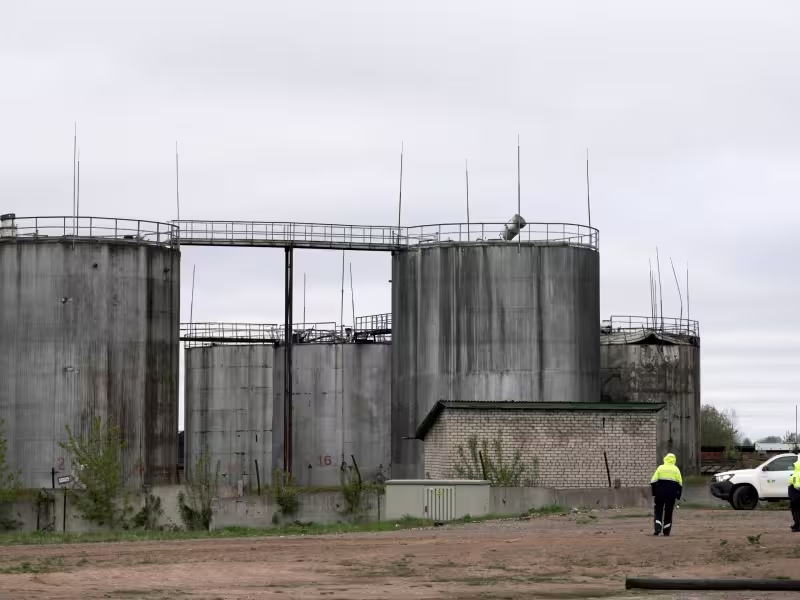
Unmanned aircraft that began falling into the Baltic states in early May have now forced a government from office in Latvia, set off air raid sirens for the first time in more than many decades and prompted temporary shut‑downs of trains and flights in Lithuania, all while a drone was shot down over Estonia last week.
Inga Ruginiene, watching the sirens and the headlines, put it plainly: "war is much closer than ever." The string of incidents—several stray unmanned aircraft that crashed in Latvia in early May, one of them damaging an oil storage facility, followed by last week’s shoot‑down and Lithuania’s suspension of some transport after another sighting—has scrambled politics and security across three NATO members.

The toll is already concrete. Early May’s crashes provoked a political crisis in Riga and led directly to the collapse of Latvia’s government; air raid warnings that sounded after the incidents were the first such alarms in the Baltics in more than many decades. All three Baltic states now report regular incursions into their airspace by Ukrainian drones—a pattern Kyiv and the Baltic capitals say is driven by Russian electronic jamming that diverts the unmanned aircraft into allied territory while they are en route to targets in western Russia.
Those claims collided with counter‑accusations from Moscow. The Russian Foreign Intelligence Service and Russia’s representative to the United Nations issued warnings accusing the Baltic states of having greenlit air corridors for Ukrainian unmanned aircraft to attack infrastructure in Russia and of hosting Ukrainian drone operators. The competing versions have turned what might have stayed a localized accident into a political and diplomatic crisis.


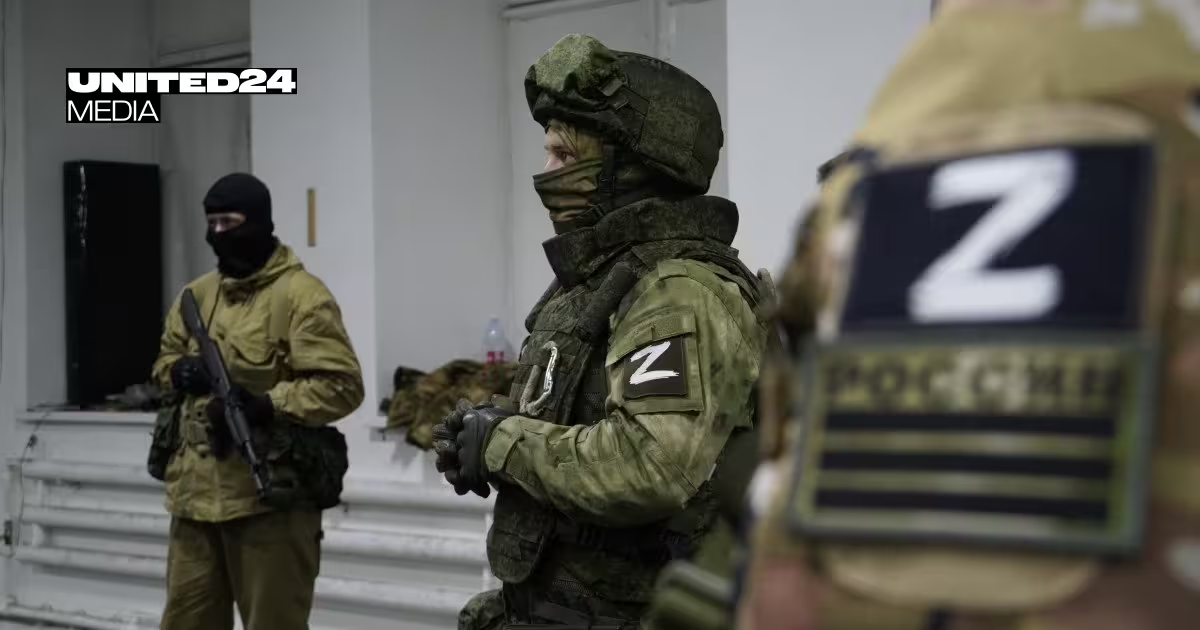
Geography helps explain why. The three NATO members sit between Russia proper and the Russian enclave of Kaliningrad, and Latvia and Lithuania border belarus to the southeast—placing routine Ukrainian operations and any navigational failure in dangerously short proximity to allied territory. Allies are already adjusting force postures: the German‑Dutch Corps is assuming responsibility for Latvia’s and Estonia’s defence, the Multinational Corps North East remains responsible for Lithuania, and a German brigade is set to establish itself in Lithuania from 2027. All three Baltic governments maintain defense spending above 5% of GDP.
The context is not neutral. The pattern of spillover is being read as the start of a new normal in Eastern European security rather than a string of isolated mishaps. Officials in Kyiv and in the Baltic capitals frame the incidents as a growing risk of spillover from the war: jamming and contested air corridors make stray drones inevitable unless de‑confliction mechanisms are put in place. Analysts and local leaders are warning that political stability is now part of the security equation—Latvia’s government fell after the crashes—and that high defense budgets and NATO deployments do not erase the diplomatic tightrope.
There is a clear tension between capability and control. On paper, NATO membership and above‑5% defense spending give the Baltic states a strong deterrent posture. In practice, the incidents expose gaps: electronic warfare can turn intended strikes into cross‑border accidents, and accusations from Moscow about greenlit corridors muddy the line between accidental spillover and deliberate provocation. Domestic politics have already been affected by the crashes, with the Latvian collapse underscoring how quickly security events can become political crises.
Even cultural and human‑interest coverage brushes against the same geography: sports pages still notice Belarusian stories even as the region braces—the French Open narrative about Sabalenka was a recent example of that crossover (see French Open Sabalenka Jewelry Glints as Belarusian Advances in Paris).
The narrowing window now is diplomatic. Militaries are repositioning and NATO command responsibilities are shifting, but those steps do not remove the single most consequential question raised by this month’s sequence: can allies and Moscow agree on de‑escalation mechanisms and communication channels quickly enough to prevent an errant drone from turning a spillover incident into a direct NATO–Russia clash?



