



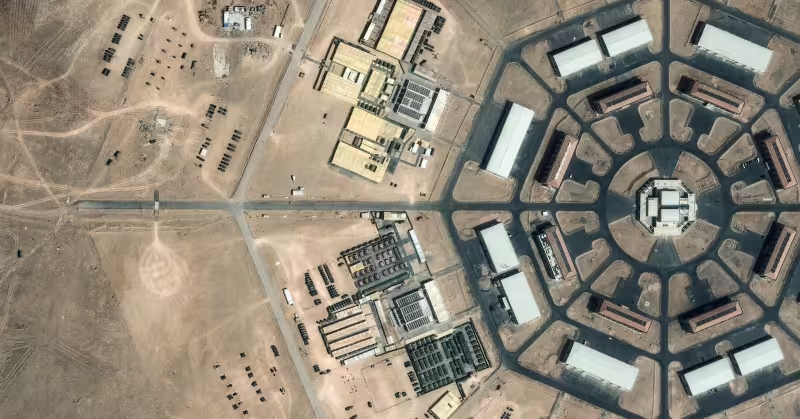
Satellite imagery reviewed by shows China has built more than 80 launch pads and three octagon-shaped installations near the Hami nuclear silo field, a sharp expansion analysts say alters the geography of the country’s nuclear forces. Alexander Neill, one of three security analysts who assessed the images, said the work is being carried out at a scale that changes how the region must be viewed.
Neill said the construction ‘‘is being built on a grand scale, covering thousands of square kilometers of desert beyond the silo fields.’’ The imagery reveals more than 80 pads that may be used by China’s expanding fleet of mobile missile launchers and air‑defense batteries, clustered close to the silo fields that experts describe as the core of China’s nuclear forces.

Among the new works are three octagon-shaped installations sited near the Hami field. Two of those octagon structures contain accommodation for personnel and large military vehicles; the third appears to function as a target range, with pock-marked earth, damaged buildings and mock-ups of Western jet fighters. The files also show construction that analysts say could support electronic warfare, satellite communications and command operations.
The images add to a broader pattern of change in China’s strategic footprint. Satellite photos cited by other imagery analysts show dramatic changes at Site 906 in Sichuan province over the past three years, including a 3,345-square-meter dome built inside a long-known nuclear weapons base. The dome is reinforced with concrete and steel, equipped with radiation detectors and armored doors, and surrounded by three layers of security fencing. Three villagers in Sichuan wrote to local authorities in 2022 asking why their land was being seized and why they were being forced out of their homes; three years after those evictions the village had been demolished and new infrastructure stood in its place.
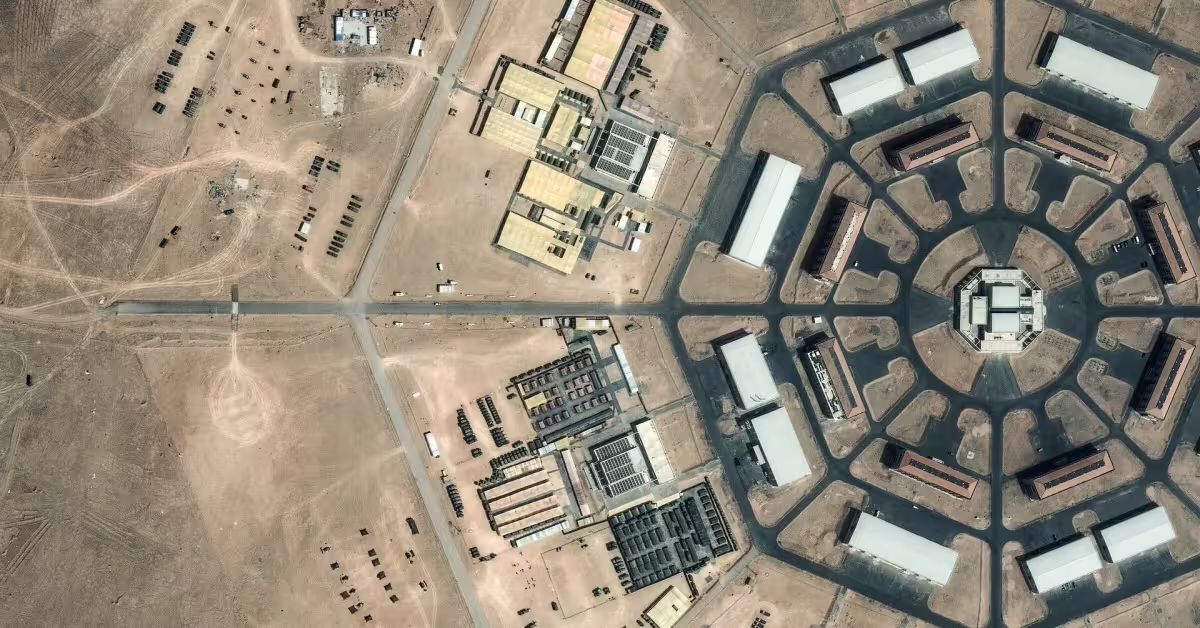
Jeffrey Lewis, another analyst who reviewed aspects of the complex, framed the new structures as both ambiguous and consequential: "This building is almost a Rorschach test that highlights people’s worst nightmares about what China is doing," he said, adding that "We are seeing a reconfiguration of this complex. This facility is a central element. It is emblematic of all these changes. It appears that, ultimately, production capacity will be much greater." Those observations underscore how the additions could multiply both real and perceived capabilities around the silo fields in Xinjiang and Gansu.
The People’s Liberation Army can also fire nuclear weapons from submarines and aircraft, but analysts and diplomats stress that the silo fields remain central. China publicly maintains a no first use doctrine and says it keeps a minimal but credible nuclear deterrent. Jiang Bin, a Chinese official quoted in state responses to the imagery reports, accused foreign commentary of bias: "distort the facts and smear China," he said, and reiterated Beijing’s declared posture: "China pursues a nuclear strategy of self-defense and applies a policy of no first use of nuclear weapons." He added that "China is committed not to using, or threatening to use, nuclear weapons against non-nuclear-weapon states and nuclear-weapon-free zones."
That official line collides with warnings from some Western diplomats and analysts who say Beijing could use nuclear coercion in a conflict over Taiwan. The contrast between declared doctrine and visible buildup is the tension that shapes the debate: imagery shows what is being built; Chinese statements insist on restraint and defense.
The stakes are immediate. A review of the satellite images comes as diplomatic engagement has failed to resolve concerns about China’s evolving nuclear capabilities, and as the two countries’ leaders exchange stark private warnings. This month, Xi Jinping warned Donald Trump that mishandling the Taiwan dispute could lead them to a "dangerous place." Mr. Trump is expected to visit Beijing next month, and the newly visible missile launch facility network will be a live backdrop to any discussion about arms, deterrence and crisis management.
The most consequential question after these images is not whether new structures exist— they do— but how Beijing intends to operationalize them and how Washington and others will respond. For now, the buildup changes the bargaining chips on the table: visible capacity has outpaced official reassurance, and the coming visit will test whether diplomacy can bridge that gap or simply acknowledge a new strategic baseline.



