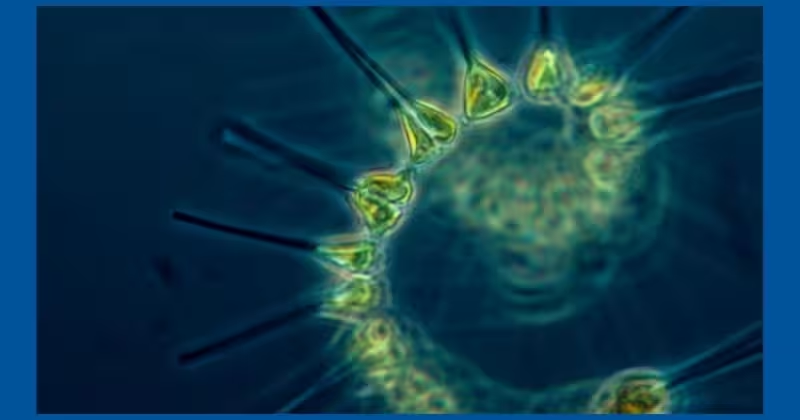
Nicolas Cassar said researchers completed the most comprehensive survey to date of DNA from microbes across the Southern Ocean and discovered that at least a third of the genes they identified are missing from existing marine gene catalogs.
The finding comes after a three-month expedition in late 2016 and early 2017 during which teams collected water samples throughout the Southern Ocean, then sequenced DNA from those samples and cross-referenced the results with data on known genes. The project divided samples into groups by genetic similarity, including groups showing clear adaptation to cold temperatures, and it returned one stark number: at least a third of the genes the team cataloged are not present in current reference collections.

“We wanted to better understand microbial diversity in the [Southern Ocean], because those microbes affect the carbon cycle in different ways,” Cassar said. When the sequenced DNA was checked against gene catalogs, he added, “When we looked at the databases, a huge portion of these genes just wasn’t there. That’s a sign we’re charting largely uncharacterized genetic territory.”
The scale of the survey — the most comprehensive to date — and its timing make the result immediately relevant. Plankton in the Southern Ocean take up carbon on a scale that matters to the planet: phytoplankton are responsible for half the photosynthesis on Earth and absorb a substantial amount of atmospheric carbon dioxide. Microbes regulate much of the ocean’s chemistry, and the genes they carry are the instruction manuals for processes that move carbon into and out of the sea.
After sequencing came the slow work of comparison. The researchers cross-referenced the raw sequences with known gene catalogs and then grouped the collections by shared genetic traits. That grouping revealed populations tailored to polar life, and it exposed a breadth of genetic material not recorded in the catalogs scientists rely on to interpret how microbes behave and interact with the environment.


The contradiction is sharp: the Southern Ocean is already recognized as outsized in its influence on global climate because of the way its plankton soak up carbon, yet the genetic basis of those microbial processes remains largely uncharted. If gene catalogs miss at least a third of the functional genes present in these waters, models that depend on existing databases could systematically understate how microbes will respond to, and shape, a warming world.
“Microbes regulate much of the ocean’s chemistry. To understand how the Southern Ocean will influence future climate, we need to understand the genes that control those microbial processes,” Cassar said, framing the immediate scientific task. That task is not merely academic: knowing which genes control carbon uptake, nutrient cycling and temperature tolerance will change how researchers project the ocean’s future role as a carbon sink.
The next step the team outlined is straightforward and urgent: dig deeper into the newly found genetic diversity to understand how it affects and is affected by climate change. Researchers plan to move beyond catalogs and sequence-driven inventories into functional studies that can tie particular genes to measurable chemical processes in the water. That work will determine whether the newly discovered genes alter estimates of carbon uptake, change timelines for ecosystem shifts, or reveal previously unseen feedbacks that could accelerate or slow climate trends.
The most immediate implication is methodological. A three-month expedition in late 2016 and early 2017 produced a dataset large enough to force a reconsideration of existing gene references for marine science. Filling the gap will require coordinated follow-up: targeted sampling, laboratory experiments to reveal gene function, and updates to the gene catalogs researchers worldwide use to translate DNA sequences into ecological meaning.
For Cassar and his colleagues, the expedition did what good exploration must: it turned a strong, familiar signal — the Southern Ocean’s role in the carbon cycle — into a sharper problem to solve. The waters around Antarctica still hold the biological recipes that run the chemistry of the planet; the surprise is how many pages of that recipe book were missing from the libraries scientists had been using.