



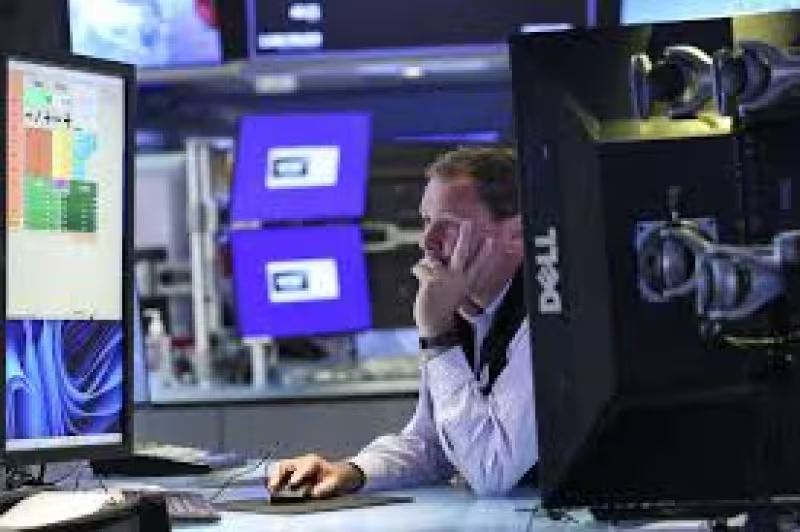
U.S. stock futures inched higher on Friday, rising 0.1% as traders digested a stronger-than-expected earnings beat from Dell and awaited an official update on U.S. negotiations with Iran. Gap CEO Richard Dickson watched the market move with his company under fresh pressure after its shares fell 15% in premarket trading when the retailer cut its full-year sales outlook.
The morning gains were modest and broad: futures tied to the Dow Jones Industrial Average, the S&P 500 and the Nasdaq 100 all rose 0.1%. Dell reported results after the bell on Thursday that beat expectations and sent its shares sharply higher — the stock closed about 40% up after the report — and the company issued an upbeat outlook, saying rapid expansion of data centers amid the AI boom would continue to drive demand for its servers. On Thursday the S&P 500 and Nasdaq each touched record highs, marking their third straight day of record closes during the week.

Sentiment on markets this week was shaped by scattered, consequential headlines. Reports circulated that a deal to extend a ceasefire between the U.S. and Iran had reached President Trump’s desk. Oil prices, which had been rising on concerns that a closure of the Strait of Hormuz would disrupt flows, fell after word that the U.S. and Iran had tentatively agreed to extend a ceasefire by 60 days; Brent crude dropped below $93 a barrel and was down about 18% for the month, while West Texas Intermediate traded near $88 a barrel.


The market moves folded in other, more idiosyncratic stories as well. Retailer Gap trimmed its full-year sales view and suffered the steep premarket selloff despite division-level gains: the Gap brand posted a 10% same-store sales increase and Banana Republic posted a 2% same-store sales gain. The company’s CEO was blunt about the weakness in one category. "We just got off to a weak start in dresses," Richard Dickson said, later adding, "We just did not have the right fashion and value equation [for dresses]."
Investors have been broadly upbeat since President Trump signaled last week that the U.S. was in the "final stages" of talks with Iran, and many have rotated into names tied to the AI trade. That rotation shows in an unusual measure of political finance: an exchange-traded fund tracking Republican lawmakers’ aggregate brokerage portfolio now lists Intel, Nvidia and the iShares Bitcoin Trust ETF among its top five holdings, reflecting a shift toward Intel and bitcoin in those accounts.
Still, the market’s rally contains friction. Dell’s blowout response to the AI-driven server cycle bolstered equities, but the deep drop in Gap shares underlines how uneven the upside remains across sectors. Oil’s retreat after the tentative ceasefire removed one immediate geopolitical premium, yet the reported deal has not yet cleared the most important hurdle: the extension still needs presidential approval to take effect.
For marketwatch readers, that is the linchpin. Stocks and oil moved on the expectation of calmer Gulf flows and stronger corporate demand from AI; Dell’s results reinforced the former, and the tentative 60-day pause calmed the latter. The single most consequential question now is whether Trump will sign the extension — if he does not, oil and risk assets could reopen the same pressures they appeared to close this week, and the gains priced into equities could quickly be tested.



