



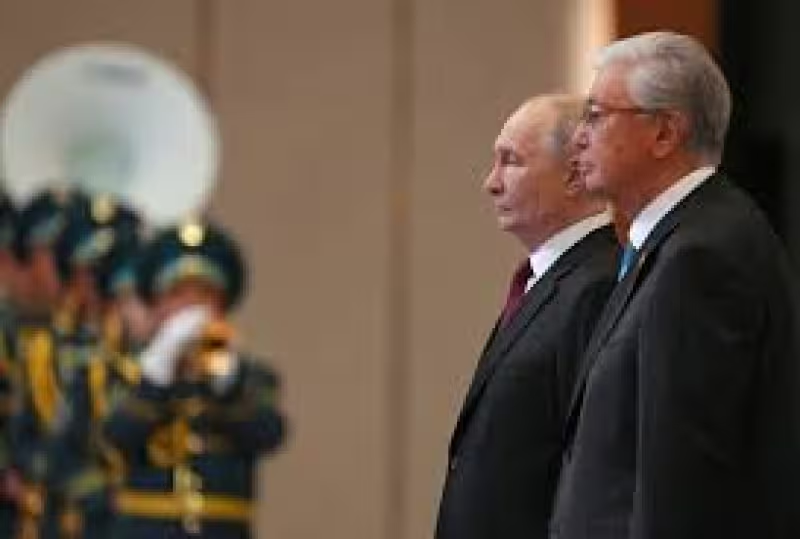
Kassym-Jomart Tokayev and Vladimir Putin signed a landmark agreement on Thursday in Astana for Russia to build Kazakhstan’s first-ever commercial nuclear power plant, a project valued at $16.5 billion that Moscow will largely finance.
The pact, concluded during high-level bilateral talks, tasks Russia’s state nuclear firm Rosatom with leading construction near the village of Ulken along the shores of Lake Balkhash and foresees two advanced VVER-1200 Generation III+ reactors. Officials said a Russian export loan will cover roughly 85% of the total cost and a supplementary report put about $2 billion of the budget toward physical security systems and social infrastructure. The construction start was targeted for 2027, with the first unit aimed to begin operation in 2034.

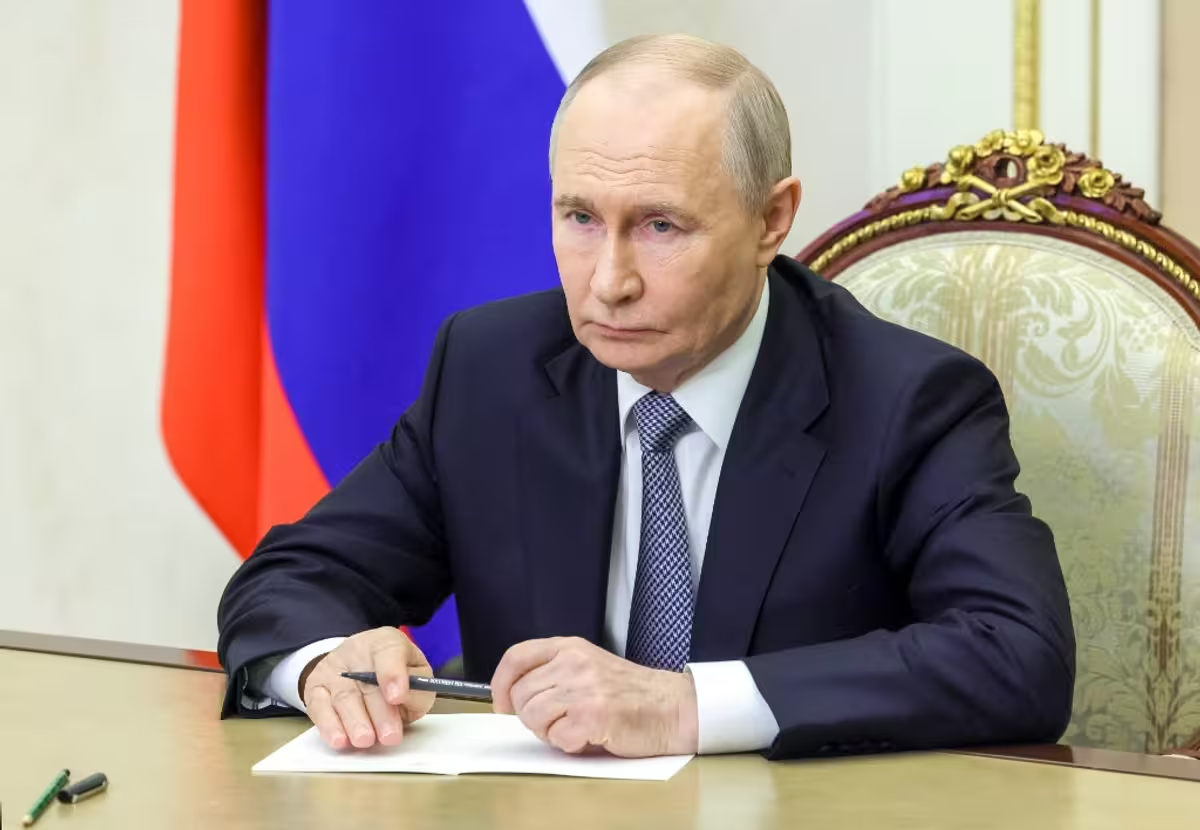
In putin news remarks on the deal, Putin called it "a flagship project in the field of peaceful nuclear energy," saying "the commissioning of the plant will make a significant contribution to the energy supply of the Kazakh economy, helping to provide businesses and households with affordable and clean energy." He added that "we are not simply talking about the creation of a nuclear power plant or construction; we are talking about the creation of an entire industry, including education, personnel training, and so on."
Tokayev framed the agreement as part of broader cooperation. "The agreement signed today on the construction of the Balkhash NPP has an important role," he said, and added: "There's every reason to single out energy as a very successful area of cooperation. In my view, the agreement signed today on the construction of the Balkhash Nuclear Power Plant is of exceptional significance." He thanked Putin, saying: "I express my gratitude to the President of the Russian Federation for his personal and decisive support in launching this large-scale project, which will become a driving force for scientific, educational, and technological collaboration and will ensure the development of new related energy sectors and industry as a whole."
The commercial scale and financial structure are the figures that show why the deal matters now: $16.5 billion in investment, a lender willing to underwrite roughly 85% of it, two large Generation III+ reactors and a timetable that sets construction for 2027 and first power in 2034. Kazakhstan’s atomic energy agency confirmed the reactor type and the multi-year timeline, and a separate intergovernmental action plan covering 2026–2030 was agreed to coordinate nuclear and radiation safety regulation during early stages of the program.
Context sharpens the stakes. Kazakhstan is the world’s largest producer of uranium but currently does not use nuclear energy commercially. The nation has struggled for more than two decades with aging, coal-reliant generation and persistent electricity deficits; officials say the new plant is intended to stabilize long-term domestic supply, diversify the energy mix and reduce CO2 emissions. Kazakhstan operates research reactors and once ran a Russian-designed BN-350 fast reactor near Aktau until 1999, but a commercial program of this size would be new.
The pact also carries an explicit geopolitical dimension. Rosatom beat out China National Nuclear Corp., France’s EDF and Korea Hydro & Nuclear Power for the primary construction mandate — a competitive outcome that reflects both technical assessment and the deep financing Kremlin backstops for projects inside the post-Soviet space. Observers will note that the agreement advances the Kremlin’s efforts to anchor economic and geopolitical influence within former Soviet states amid Western sanctions.
The tension in the deal lies in the trade-offs it creates for Astana. Heavy reliance on Russian finance and technology comes with clear short-term payoff — funding and a path to break Kazakhstan’s energy bottleneck — but it also ties Kazakhstan’s long-term infrastructure, training and regulatory path to a single foreign partner. The supplementary $2 billion allocation for security and social infrastructure acknowledges part of the complexity, while the interdepartmental safety plan for 2026–2030 signals a recognition that regulatory and institutional work must follow the headline contract.
This agreement will reshape Kazakhstan’s energy map and deepen Moscow’s economic footprint in Central Asia. Given the scale of Russian finance and the technical lead Rosatom will have over both construction and related industrial development, the clearest immediate consequence is that Kazakhstan’s nascent civilian nuclear program will be built around Russian reactors, training and regulatory cooperation — a structure likely to endure through the plant’s commissioning and beyond.



