

























Spinosaurus discovery forces a rethink of its lifestyle and evolution — inland 'hell heron' species shifts the debate

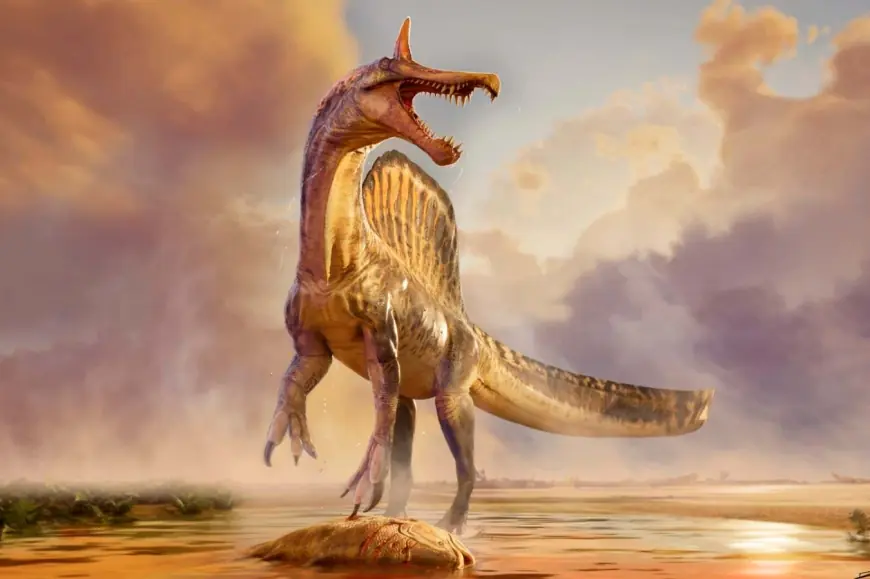
The naming of a new species, Spinosaurus mirabilis, matters because it changes where and how researchers will look for answers about these sail-backed predators. Found in the Sahara and dated to about 95 million years ago when the region was a river-rich wetland, the fossils point strongly toward a wading, display-driven animal rather than a fully aquatic swimmer — a shift that redirects field priorities and reframes key anatomical features.
Why this Spinosaurus find alters the swimming-versus-wader debate
Here’s the part that matters: fossils from an inland desert site place Spinosaurus mirabilis hundreds to a thousand kilometres from ancient shorelines, in what would have been river and forest habitats. That inland setting, combined with skull features and limb proportions described by the research team, supports the interpretation that these animals behaved more like giant herons — wading and stalking fish in shallow water — rather than being specialized divers.
Display anatomy also becomes central to the new narrative. The newly described Spinosaurus had a pronounced sword- or scimitar-shaped crest on its head and the familiar sail along its back; the crest’s bony core would have been amplified in life by a keratin sheath, making it visually prominent. These elements are understood to have served visual roles: attracting mates, intimidating rivals, and signalling health or territory along open riverbanks.
The fossils and what they show
The material recovered includes remains from multiple individuals, enabling a more complete reconstruction of skull and crest anatomy. Notable details in the finds include interlocking, interdigitating teeth that project to form an effective trap for slippery fish, and a crest structure delicate enough to be unsuitable as a weapon but well suited to vivid display.
- Location: central Sahara desert exposures that were once riverine wetlands.
- Age: placed at roughly 95 million years old in the Cretaceous context.
- Physical highlights: a tall, curved crest with a bony core and a probable keratin sheath; sail along the back; jaw and tooth arrangement adapted for catching fish.
If you’re wondering why this keeps coming up, the answer is that previous Spinosaurus material came largely from coastal deposits, which fed the idea of an aquatic, diving lifestyle. The new inland finds show these dinosaurs also occupied river systems far from shore, which changes the ecological picture for the group.
What’s easy to miss is that the crest and sail are part of a broader behavioral toolkit: visual signals become a plausible explanation for several of the most conspicuous spinosaur features, not mere curiosities.
Researchers framing of evolutionary stages in this group provides a time-layered context: an initial Jurassic phase where elongated skulls evolved for fish-catching, a later phase in the Early Cretaceous when relatives spread along ancient coasts, and now a third phase where species like the newly named Spinosaurus mirabilis specialized as shallow-water predators in inland northern Africa.
- Phase 1: Jurassic — skull elongation for piscivory.
- Phase 2: Early Cretaceous — coastal expansion of spinosaur relatives.
- Phase 3: mid-Cretaceous — inland, shallow-water specialists such as Spinosaurus mirabilis.
Key takeaways:
- Spinosaurus mirabilis strengthens the case for a wading, display-oriented lifestyle among spinosaurs rather than exclusive aquatic pursuit behavior.
- The discovery comes from inland wetland deposits, shifting field attention away from just coastal sites.
- Large cranial crests and sails are interpreted primarily as display structures enhanced by keratin sheaths, not weapons.
- Multiple individuals in the same deposits allowed reconstruction of features that had been missing or fragmentary before.
- The find reframes an evolutionary sequence that moves from skull specialization to coastal spread to inland shallow-water specialization.
The real question now is how many other spinosaur species lived in similar inland settings and what further surprises their better-preserved remains might reveal. Recent updates indicate researchers will be prioritizing inland river deposits and finer-preserved specimens to test the wader model and to clarify the role of visual display in these remarkable dinosaurs.