

























Winter Storm Watch: Storm Maps Show Where Rain, Sleet and Snow Will Hit Friday Across New England

A winter storm watch keyword has figured prominently in forecasts as New England prepares for a complex system expected Friday that will bring cold air, freezing rain, sleet and eventually snow. The mix and timing will drive travel conditions, including a slippery Friday evening commute in many areas.
Winter Storm Watch: What happened and what’s new
Forecasters say the next winter system will arrive Friday afternoon and intensify through the evening, producing a mix of precipitation types before tapering off overnight into Saturday. An initial warm front will push east ahead of the storm’s core, and there is a notable chance that a secondary low will form over the ocean, which could boost precipitation at times.
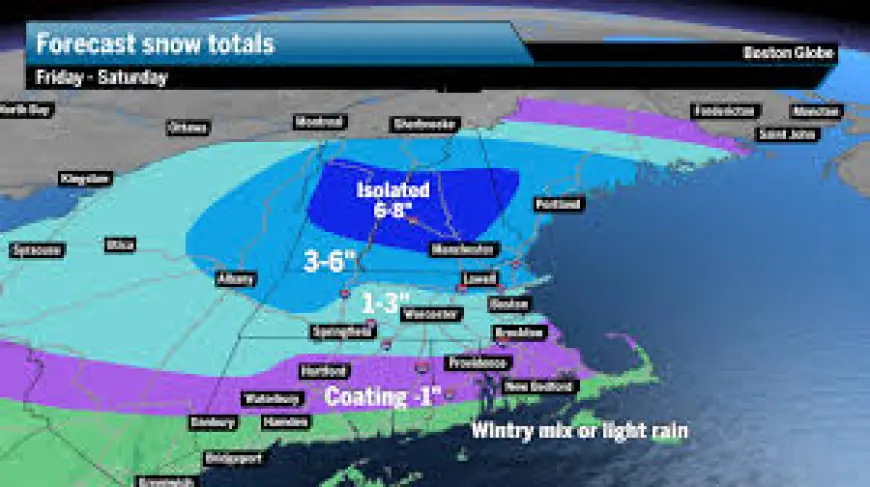
Expectations for Southern New England begin largely as a wintry mix and cold rain, especially along the coast and in Boston and areas south of the Massachusetts Turnpike. The rain-snow line is forecast to shift southward Friday evening into the night, with Boston currently projected to receive between 1 and 3 inches of snow by noon Saturday and higher totals north of the city.
Northern New England is expected to see snow from the start of the event, with general totals of 3 to 6 inches and isolated 6- to 8-inch amounts in parts of New Hampshire, Vermont and western Maine. Forecast mapping breaks the region into impact zones: 6 to 8 inches in central Vermont and New Hampshire and parts of western Maine; 3 to 6 inches north of key east-west corridors and north of Boston; 1 to 3 inches across Greater Boston and several interior southern New England communities; coating to 1 inch on the South Shore, Providence, Hartford and the Outer Cape; and rain or wintry mix along the southern coast including much of the Cape and islands.
In Massachusetts specifically, a winter weather advisory is set for a broad swath of counties from 10 a. m. Friday to 7 a. m. Saturday. Northern parts of the state, particularly north of Interstate 90, are expected to see mostly wet snow with accumulations in the 3-to-5-inch range and up to about 6 inches near the New Hampshire line. Areas along and south of Interstate 90 should plan for a mix and generally lighter snow accumulations, often a coating to 2 inches. Some parts of central and western Massachusetts could see significant ice accumulation.
Behind the headline
This system has a setup similar to an earlier midweek event but with more atmospheric moisture available to generate widespread precipitation. Key dynamics include the warm front preconditioning coastal zones to rain or a wintry mix, the potential development of a secondary ocean low that could enhance precipitation rates, and cooling temperatures late Friday that will allow a transition toward snow in many areas.
Stakeholders range from commuters and school systems to road crews and utility managers. The weather advisory window and forecast timing put particular pressure on the Friday evening commute, with forecasters flagging slippery roads and travel delays. Coastal communities face the added complexity of mixed precipitation regimes that often shift rapidly as the rain-snow line moves.
What we still don’t know
- Whether the potential secondary low will form over the ocean and, if it does, how much it will amplify precipitation rates.
- Exact snow and ice totals for many communities, especially where the rain-snow transition is expected to occur.
- How far south the rain-snow line will move overnight Friday and which coastal communities will switch to accumulating snow.
- The localized extent of significant ice in central and western Massachusetts.
- Whether the coastal system tracked for Sunday night into Monday will shift close enough to shore to produce gusty winds or ocean-effect snow.
What happens next
- Secondary low forms and strengthens: precipitation rates increase, coastal precipitation changes faster, and some interior totals rise. Trigger: observed organization over the ocean Friday afternoon.
- Main storm stays weaker offshore: coastal areas remain largely rain or mixed precipitation while interior zones see the expected snow totals. Trigger: limited development of the secondary low.
- Rain-snow line shifts farther south than expected: more coastal communities see accumulating snow overnight into Saturday. Trigger: faster cooling late Friday evening.
- Significant icing in western and central counties: travel becomes hazardous and outages are possible where freezing rain persists. Trigger: prolonged subfreezing surface temperatures under warm-layer precipitation.
- Follow-up coastal system impacts minimal: models that favor an offshore track keep Sunday night into Monday effects limited. Trigger: storm track remains well off the coast.
Why it matters
Near-term impacts include hazardous travel during the Friday evening commute, especially where freezing rain and sleet create slick surfaces. Snow accumulations north and west of urban centers may affect road clearing priorities and local school or municipal operations. Coastal and southern areas must plan for changing precipitation types and the potential for a quick transition to accumulating snow as temperatures fall. In the days after, attention will shift to whether the later coastal system brings additional wind or snow impacts.