






















Toy Story 5 Trailer Reunites Woody and Buzz as the Gang Confronts an Existential Tech Threat

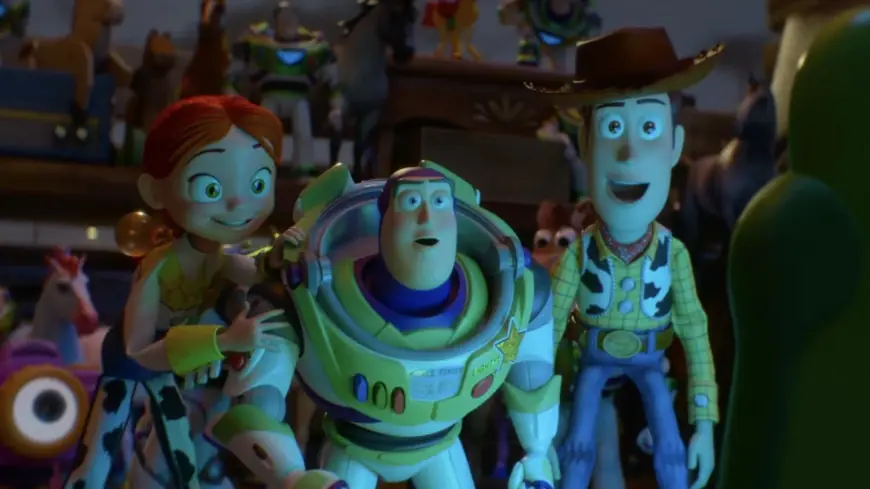
The new Toy Story 5 trailer reunites classic characters and sets up a modern conflict: the toys must adapt when a frog-faced tablet named Lilypad begins to dominate their child owner’s attention. The trailer signals a return to the emotional center of the franchise while foregrounding a contemporary "toys versus tech" premise.
Toy Story 5: What happened and what’s new
The full trailer for Toy Story 5 presents a reunited core group—Woody, Buzz, Jessie and the rest—facing a disruptive newcomer in the form of Lilypad, a frog-like tablet voiced by Greta Lee. The clip shows Buzz and Woody reconciling and trading familiar barbs, with elements designed to evoke nostalgia alongside an explicit theme of obsolescence: the toys’ roles are challenged when the tablet becomes Bonnie’s constant companion.
Principal voice cast members return, with Tom Hanks as Woody and Tim Allen as Buzz. Joan Cusack is back as Jessie, and established characters including Forky and Duke Caboom appear in the trailer. Some cast changes are visible: Mr Potato Head is now voiced by Jeff Bergman. New additions among the vocal performers include Conan O’Brien as a character called Smarty Pants, Craig Robinson as Atlas, Ernie Hudson as Combat Carl, Shelby Rabara as Snappy, and Anna Vocino and Scarlett Spears in supporting parts. The trailer also teases visual gags such as a Multi-Buzz figure and callbacks to fan-favorite comedy beats.
Director Andrew Stanton, who has previously led two other major animated films, directed this installment and framed it around the passage of time and change. The production will feature another original score by Randy Newman. The film is scheduled to open in cinemas on 19 June.
Behind the headline
The trailer frames the central conflict as technological displacement rather than a physical antagonist: Lilypad is presented as benign but attention-stealing, prompting the toys to ask whether playtime and their purpose can survive modern devices. That framing allows the film to revisit longstanding franchise themes—friendship, purpose and adaptation—while updating the stakes for a generation whose play patterns are shaped by screens and smart devices.
Stakeholders are straightforward: the returning toys and voice cast anchor audience goodwill; the new characters and tech-focused premise aim to broaden the story’s relevance; and the creative leadership emphasizes continuity with earlier tone and craft. The cinematic release date positions the film for a traditional theatrical rollout rather than a streaming debut.
What we still don’t know
- How Lilypad’s personality and actions will drive the plot beyond occupying Bonnie’s attention.
- Specific plot beats that explain Woody and Buzz’s reunion in detail.
- How the new characters will influence the central conflict and which toys will take leading roles.
- Box office strategy, international release schedule and promotional plans beyond the trailer and the stated release date.
- Complete creative team credits beyond the director and composer mentioned in the trailer coverage.
What happens next
- Wide theatrical release on 19 June: the trailer sets expectations for a conventional cinema opening that will test audience appetite for another sequel.
- Promotional campaign escalation: additional clips, interviews and character reveals could clarify Lilypad’s role and the returns of legacy characters.
- Critical and audience reaction split: the film may be evaluated on its emotional continuity with earlier entries or judged by how plausibly it integrates a tech-focused theme.
- Merchandising and cross-platform tie-ins: the prominence of a tablet-shaped character suggests potential for new product designs and marketing angles tied to devices and apps.
Why it matters
The trailer for Toy Story 5 signals the franchise’s effort to reconcile nostalgia with contemporary cultural concerns about screens and childhood play. For audiences, the film promises a familiar emotional register while asking whether beloved characters can retain meaning when the context of play changes. For the studio and creative team, the project tests whether a long-running property can renew itself by addressing present-day habits without losing its core appeal. In the near term, the trailer’s reception will shape expectations ahead of the June theatrical release and influence how the film is marketed to families and long-time fans.