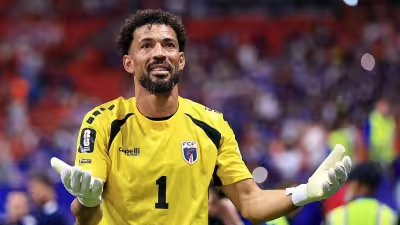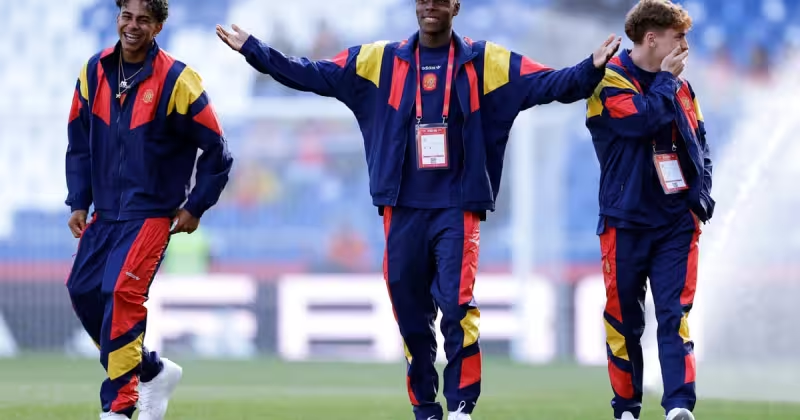
Spain begins its World Cup on Monday in Atlanta against Cape Verde, stepping onto the tournament stage as a joint favorite with France and with a path that, if everything goes right, ends at MetLife Stadium in New Jersey on July 19.
The expectation is not empty: Spain have won the World Cup once and four European Championships, and pre-tournament billing places them among the teams most likely to go deep. The opener in Atlanta is the immediate test — a single match that starts a sequence of group games and knockouts leading to the July 19 final, where the trophy lift would play out on U.S. soil.

That sporting story arrives against an unusually public political backdrop. Relations between Madrid and the U.S. president have deteriorated: Donald Trump has repeatedly attacked Spain’s posture, calling it a laggard and saying, "Maybe you should throw them out of NATO, frankly," and in March telling the New York Post, "We have a lot of winners, but Spain is a loser." The rupture began with Madrid’s refusal last year to raise defense spending to the level Washington demanded; Spain kept its defense expenditure at 2.1 percent of GDP while Trump pushed NATO partners toward a 5 percent target.
Prime Minister Pedro Sánchez framed that 5-percent demand in stark social terms, warning it would mean "eliminating unemployment, sickness and maternity benefits, reducing all pensions by 40 percent, or cutting state investment in education by half." The disagreement has widened into other foreign-policy fault lines: Spain refused U.S. requests to use joint bases on Spanish territory for an offensive against Iran, and Sánchez described those attacks as "unjustified and dangerous." In 2024 Spain, along with Ireland and Norway, recognized the state of Palestine, and Sánchez’s government was the first in the EU to accuse Benjamin Netanyahu’s administration of genocide. All of which leaves Spain’s World Cup campaign playing out while its national leadership and the tournament’s host-country president remain sharply at odds.


That friction matters because sport often becomes a proxy for national standing. A Spanish run to the final would hand a visible moment of national pride to Sánchez at home and project an image internationally that may blunt some of the political heat. Conversely, failure on the pitch would hand critics — including a president already inclined to mock Spain publicly — a tangible talking point.
Practical details are straightforward for fans: Spain meet Cape Verde in Atlanta on Monday; the squad then moves through the group stage toward potential knockout ties and the July 19 final at MetLife Stadium in New Jersey. The team’s blend of experience and youth is the reason for the favorite tag; young winger Lamine Yamal is among the players expected to matter, but the tournament will be decided by collective form rather than individual billing.
What to watch when the ball is kicked: can Spain convert pre-tournament favoritism into consistent performances, starting with clean, composed play in Atlanta? Can the side avoid the defensive lapses and ill-timed errors that routinely unseat favorites in single matches? And beyond tactics, the storyline to follow is whether a successful run will turn sport into fresh political capital for a government currently in open conflict with the U.S. president tied to the host country.
The central unresolved question of this World Cup is simple and consequential: will Spain turn favoritism into wins and, ultimately, lift the trophy at MetLife Stadium on July 19? The answer will determine not only how the team is remembered in football terms but how a deeply public diplomatic rift looks in the rearview of a tournament whose finale will be watched around the world.