



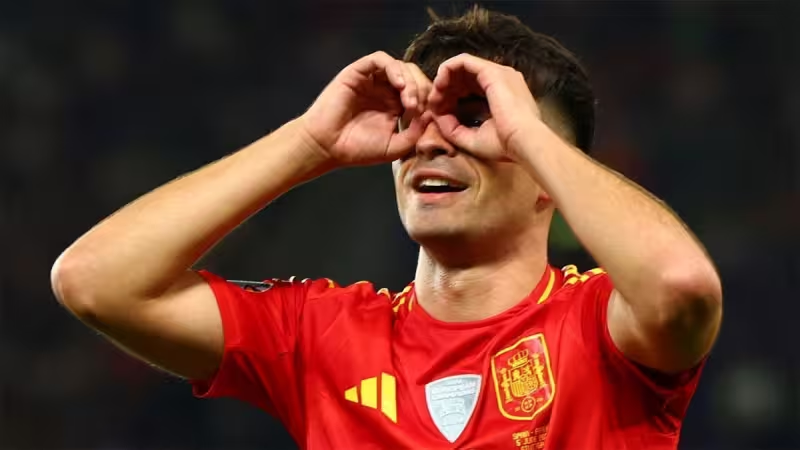
“Es donde desconecta de todo para luego volver a conectar. Con el Barça, con la selección...” Rubén said of the villa in the south where Pedri retreats when he comes home — a short, private ritual that the Tenerife midfielder keeps between tournaments, clubs and the island that raised him.
The detail matters because Pedri is due to make his first appearance in a second World Cup for Spain, and a lot of the story people expect to see when he walks onto a pitch began in a place of fewer than 11,000 inhabitants. Those opening steps came in Tegueste’s Escuelita and, at 14 years old, he left the municipal team to join Juventud Laguna, the decisive move that pushed him toward professional football.

Tegueste is both modest and specific: a village known for wine, bodegas and the spring Romería de San Marcos, hemmed by the Parque Rural de Anaga and home to the Barranco de Agua de Dios archaeological site. It is also the climate in which several professionals learned their trade — Jeffren Suárez, Omar Mascarell, Joaquín González and Samuel Pérez, who later played matches in Primera and Segunda.
Local memory supplies the heft. Eladio Ramos, recalling family ties to the game, frames Pedri’s emergence as almost inevitable: “La leyenda de Pedri comenzó con su abuelo, que fundó la peña del Barça; y luego con su padre, que era también un seguidor total.” Joaquín González adds the shorthand of practice-ground admiration: “Era un máquina.” Those voices are the proof of cultivation, not just a passing talent.
Context underlines a wrinkle: club records and FIFA’s administrative view don’t map perfectly onto Tegueste’s recollection. Pedri’s time in his hometown club stretched across childhood, but FIFA documentation credits him with two years in the green team. The discrepancy — many years remembered locally, two years formally logged — has no bearing on his ability, but it does reshape the official timeline of where and how much the municipality claims credit.

That tension makes Tegueste’s pride both familiar and precise. Norberto Padilla, speaking for a town more often described by vineyards than by ball skills, put it simply: “Antes éramos conocidos por el buen vino, las bodegas... y ahora a nivel mundial por un futbolista con una clase exquisita, que disfruta con lo que hace.” The claim is not exaggeration so much as a local recalibration of identity: the same streets that produce a Romería now produce midfielders.
The pathway to the professional ranks is clear in the facts: the Escuelita provided Pedri’s first touches; CD Tenerife tracked him closely; at 14 he moved to Juventud Laguna, which gave him the final push toward a career that eventually took him to Barça and the Spanish national team. Those steps explain how a boy from a tiny town came to be one of Spain’s key players going into an autumn World Cup.
Still, this is not only a tale of small-town origin. It is a portrait of management and measurement: the municipality’s long stewardship of a young player is at odds with a short, formal FIFA record. That mismatch won’t be settled in a press conference; it lives in club archives and in the memory of coaches who watched him grow.
Spain’s coach has already spoken of the mood Pedri brings — “botes de alegría,” Luis de la Fuente said — and the team expects that influence to show up on the field. What remains open is how far Pedri’s World Cup run can go and whether the relaxed ritual Rubén describes and the formative years in Tegueste will translate into the kind of consistent, tournament-level dominance Barça has seen from him.
For now, Tegueste waits and watches: a town that once gauged itself by harvests now times its applause to a different calendar. Pedri will return to his villa, then to the pitch; whether the small, private pauses between will produce big, public moments in this World Cup is the single question left for the tournament to answer.



