
Costco Wholesale is posting membership and digital gains that would normally excite investors: U.S. and Canada renewal rates of 92.2%, a worldwide renewal rate of 89.7%, a 37% jump in site and app traffic in the quarter and a 21.5% rise in digitally enabled comparable sales — even as the shares trade at a rich forward price-to-earnings ratio of 43.1.
Those operating numbers are the reason Costco appears at the center of one of the clearest retail stock matchups for 2026: costco stock versus Walmart and Amazon. Costco’s five-year share gain of more than 150% and the company’s 0.6% dividend yield — plus a notable one-time $15-per-share special payout in 2024 — underscore how membership loyalty and bulk merchandising have driven both cash flow and investor returns.

By contrast, Walmart brings a different promise: dividend durability and steady cash returns. It is the only Dividend King on the list, having raised its payout for 53 consecutive years, and its shares have also climbed over 150% in the past five years. Walmart is layering technology into that stability — from its AI shopping agent Sparky to rising revenue from Walmart+ membership and a growing advertising business — a combination management argues smooths volatility across consumer segments.
Amazon’s case is neither bulk nor dividends but cloud-driven scale. Its 2026 first-quarter report disclosed new AWS agreements with Anthropic, Meta Platforms, Nvidia, OpenAI and Uber Technologies, and AWS revenue grew 28% to $37.6 billion — the company’s fastest growth in 15 quarters. For investors who prize platform leverage and margin-rich services, Amazon’s path looks structurally different from a warehouse club or a discount chain.
The numbers sharpen the tradeoffs. Costco’s renewal rates and the surge in digitally enabled sales argue for a business that can expand margins and monetise a sticky base, while Walmart offers predictable cash returns and defensive reach across income cohorts. Amazon offers high-growth, high-margin services beyond retail. Yet the friction is obvious: investors did not reward Costco’s otherwise strong quarter in the way its operating results suggested they should, leaving the stock priced at a forward P/E of 43.1 — elevated relative to what many value-minded buyers expect from a retailer.


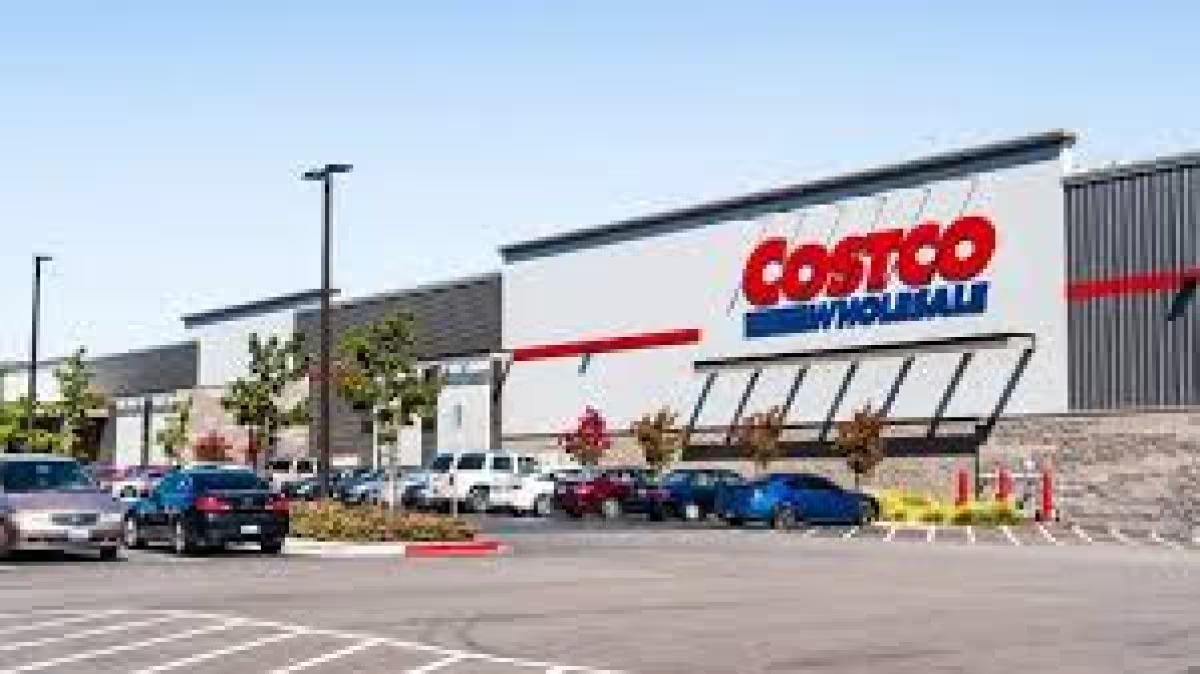
That valuation gap is the key tension in this three-way comparison. Costco’s membership economics and Kirkland-quality private label underpin an unusually loyal customer base; management said recent weeks produced record-breaking volumes and that the company’s final five weeks of the quarter ranked among its top five volume weeks ever. Those are concrete signs of demand. Still, a forward P/E north of 40 forces buyers to assume continued strong premium growth or accelerating margins to justify the multiple.
Walmart’s CFO has sounded the consumer split that frames part of the choice: higher-income shoppers are still spending with confidence while lower-income customers are more budget-conscious, and fuel-center behavior is shifting — Walmart’s fuel customers are averaging less than 10 gallons per visit, a small but telling change in trip economics. That nuance matters because it shows why Walmart wants both technology to raise basket size and recurring revenue through memberships and ads.
Amazon’s AWS momentum answers a different investor question: can the company generate secular margin expansion outside of retail? With AWS agreements announced across several major AI players and the fastest revenue growth in over three years, Amazon is selling exposure to an infrastructure cycle that could decouple its valuation discussion from retail comps.
The practical choice for 2026 comes down to what investors believe will drive returns next: will Costco’s membership loyalty and a 37% surge in digital traffic convert into enough earnings growth to make a 43.1 forward P/E reasonable? Or will Walmart’s steady dividend track and newer tech-driven revenue streams look safer? Or will Amazon’s AWS-led acceleration dominate the narrative?
The most consequential unanswered question for investors is which of those outcomes is likelier: sustained earnings expansion at Costco large enough to justify its premium multiple, continued dividend-backed resilience at Walmart, or outsized margin and revenue gains from Amazon’s cloud business. That judgment — not a single metric — will determine which of the three is the better stock pick for 2026.