



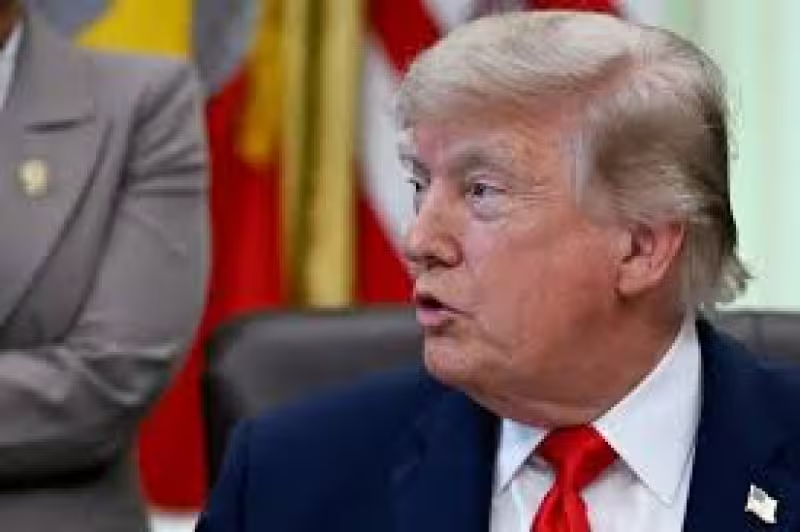
President Donald Trump said Friday that a "swift and lethal kinetic" U.S. strike killed Hector Rusthenford Guerrero Flores, whom he called "the infamous leader" of the Tren de Aragua gang.
Trump posted on his social media site that "Tren de Aragua terrorists no longer have safe haven in Venezuela or anywhere else and, under my leadership, we will find these vicious murderers and drug lords anytime, anyplace, and send them to the depths of hell where they belong." He tied the announcement to a wider campaign his administration has pursued against the group.

The claim lands on top of a string of formal legal steps taken against Guerrero Flores and Tren de Aragua: in December he was charged in a New York federal court with racketeering conspiracy and related offenses that prosecutors say include lending support to terrorists in crimes stretching more than a decade. The Justice Department and prosecutors have accused the group of extortion, drug trafficking and widespread violence across North America, South America and Europe, and the U.S. State Department put rewards of up to $5 million for information leading to Guerrero Flores’ arrest.
Officials have repeatedly declared Tren de Aragua a terrorist organization and the administration has already carried out a series of actions it says were aimed at the group, including strikes on small boats accused of smuggling drugs to the United States. In January the U.S. removed Nicolás Maduro from Venezuela to face drug charges in the United States, a move the administration framed as part of its pressure campaign against networks tied to illicit trafficking.
Those steps are the immediate backdrop for Trump’s Friday statement, which frames the strike as another direct blow to the gang’s leadership. U.S. Attorney Jay Clayton and other prosecutors detailed the December case by saying Tren de Aragua was responsible for "countless acts of violence, extortion and drug trafficking" across multiple continents — charges that helped set the legal groundwork for transnational enforcement efforts.
But the administration’s narrative has a clear friction point. Trump has for months insisted that Tren de Aragua operated under Maduro’s control; a declassified U.S. intelligence assessment, by contrast, found that claim to be incorrect. That contradiction undercuts one of the administration’s central justifications for treating the group as an arm of Venezuela’s government rather than as an autonomous criminal organization.
Crucially, the president’s announcement does not include independently verifiable details that would normally follow a claim of a targeted strike: the location of the strike, which units carried it out, and confirmation from law enforcement or intelligence agencies that Guerrero Flores was killed. The public record does include the December federal indictment and the State Department reward offer of up to $5 million, but it does not yet provide proof tying those legal actions to the operation Trump described on Friday.
The immediate consequence is political and operational: the administration is presenting the strike as evidence of a sustained, cross-border effort to dismantle Tren de Aragua’s leadership while recycling a familiar line that the gang can find no safe haven. What remains unresolved is whether the factual claim about Guerrero Flores’ death can be corroborated by independent investigators or confirmed by U.S. law enforcement — and whether the contradictory declassified assessment will prompt closer scrutiny of the administration’s broader narrative linking the gang to Maduro.
Officials have vowed to keep pursuing the organization; Trump’s message reiterated that posture. Absent independent confirmation of where the strike occurred or forensic evidence that Guerrero Flores was killed, the announcement stands as a high-profile claim with major legal and diplomatic implications but with key facts still unverified.



