



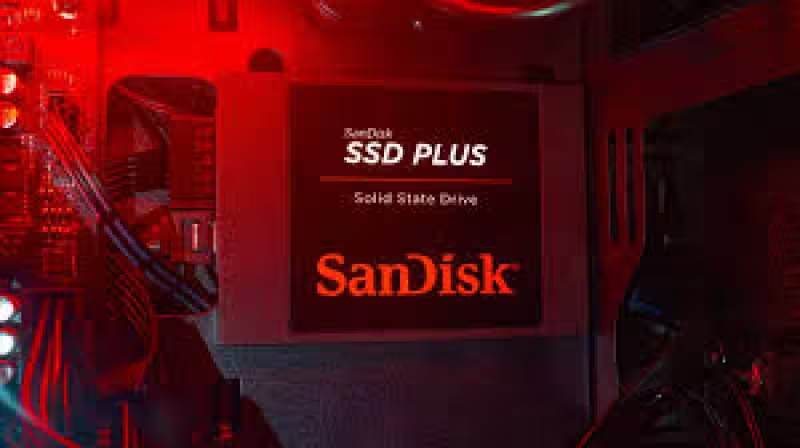
Morgan Stanley and Susquehanna raised price targets on Sndk this week, lifting their upside calls as memory prices surged: Morgan Stanley moved its target on June 3 from $1,100 to $1,750 while keeping an Outperform rating, and Susquehanna raised its target over the past week from $2,000 to $3,250 and left a Buy rating in place. Both firms pointed to a tight memory market as the driver — Susquehanna flagged DRAM average selling prices rising 50% to 60% quarter-over-quarter and NAND tracking up 75% to 100% — and Susquehanna said its checks put DRAM pricing slightly ahead of a 50% consensus expectation.
The upgrades carried immediate consequences for investors: Susquehanna said the pricing surge forced it to raise estimates across its memory manufacturer coverage, a direct lift to revenue and margin assumptions for NAND specialists. Morgan Stanley framed its case around a persistent shortage in memory supply and a stubborn imbalance in the market, warning there is "no quick fix" and projecting tight conditions to last two to three years or longer. Those supply-side forecasts underpin both firms' willingness to widen their targets even after large share gains in recent years.

Susquehanna’s math is explicit: Q2 DRAM selling prices are trending up 50%–60% q/q and are slightly ahead of the 50% consensus. NAND, the flash technology that underpins Sandisk Corporation’s products, is moving faster still, with Susquehanna tracking a 75%–100% q/q lift. That pricing momentum was the analytical lever for the new $3,250 target, and the firm said the move prompted across-the-board estimate upgrades among memory makers — a sign analysts expect stronger near-term profit capture if the price trend persists.
Sandisk Corporation’s business is squarely in the part of the market benefiting from those gains. The company develops, manufactures and sells NAND flash–based storage devices and solutions, including solid-state drives, memory cards and USB flash drives. Higher wholesale NAND and DRAM prices translate into a clearer path to outsized revenue growth and margins for vendors with scale in NAND, which is why both firms held bullish stances rather than trimming them.

Yet the record of strong returns in 2025 and 2026 complicates the upbeat message. Analysts note Sandisk shares already climbed hard on the initial wave of tighter supply and AI-driven storage demand; Morgan Stanley, even after raising its target to $1,750, explicitly said the rally still has room to run despite the company’s strong performance over the last two years. That admission is the story’s friction: firms are increasing their mathematical expectations for cash flows and profits while admitting the stock has already priced in much of the narrative.
The immediate market implication is straightforward — analysts are expecting more good news in memory pricing and are translating it into higher price targets and earnings estimates. The practical takeaway for shareholders is that analysts see sustained supply pressure and robust pricing as the foundation for higher valuation benchmarks. Coverage adjustments from Susquehanna and Morgan Stanley arrived as pricing data for Q2 showed outsized gains, and one can trace the link from price moves to target moves in their published notes.
What remains unresolved is how much farther Sndk shares can climb. Both firms boosted targets on the same fundamentals but to very different levels, and neither offered a ceiling for upside. Morgan Stanley’s two- to three-year-plus supply window and Susquehanna’s aggressive Q2 pricing assumptions sharpen the bullish case, but they do not quantify the ultimate limit of the rally. Investors will now watch upcoming pricing releases and quarterly results closely; the next meaningful answer will be whether NAND and DRAM moves sustain at the current pace or slow, and how Sandisk’s revenue and margin trajectory responds.
For background reading on recent market moves that set this stage, see coverage of Sndk's recent share behavior and earnings-driven repricing ( and Analysts have increased conviction this week; the central open question—how much higher the market will price Sandisk’s upside—remains the most consequential item for shareholders.



