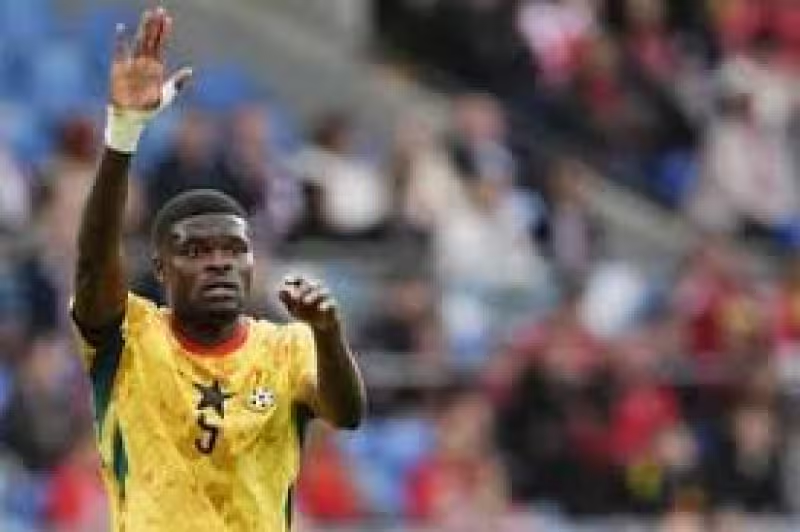
Canadian authorities have refused a visa for Thomas Partey, meaning the Ghana midfielder will not travel to Toronto and will miss his country’s World Cup opener against Panama at BMO Field on Wednesday, June 17.
FIFA confirmed the decision on Tuesday: "FIFA can confirm that player Thomas Partey will be unable to travel from Ghana’s team base camp in Boston, USA, to Canada for their first match against Panama on Wednesday, 17 June, as his visa application has been refused by the Canadian government." FIFA added that "FIFA is not involved in the immigration processes of host countries, including the adjudication of visas" and that "the host government ultimately determines who receives a visa and is admitted into the country." Partey arrived in Washington, D.C. with teammates on June 4 and the squad travelled to its training base in Rhode Island on Friday.

Partey, 32, is facing seven counts of rape and one count of sexual assault that will be tried at Southwark Crown Court in London. He has pleaded not guilty to the charges. The case was originally set for November but may now be delayed until early 2027, and under the terms of his bail he must notify authorities of any plans to travel abroad.
Canada’s immigration service declined to give case-specific details, citing privacy. "Without any signed consent form, it is not possible for IRCC to provide details regarding any individual situation," an Immigration, Refugees and Citizenship Canada statement said. The department added that "the safety and security of Canadians is our priority as we welcome FIFA World Cup participants and visitors from around the world" and that "IRCC officers are trained decision makers who assess an individual’s eligibility and admissibility in accordance with Canadian immigration laws," including the option to refuse entry if they "believe that an individual could pose a security risk." The Canadian government website also warns that people who have committed or been convicted of a crime may not be allowed into Canada.


The refusal creates a clear legal and sporting friction: Partey has been charged but not convicted. The charges include an initial set of six alleged offences relating to three women in 2021 and 2022, and two further counts connected to a fourth woman; detectives at the Metropolitan Police began investigating in February 2022. Partey was first charged in July 2025 with five counts of rape and one count of sexual assault and pleaded not guilty in September 2025. He was charged with two additional counts in February this year and pleaded not guilty to those in April.
On the field, the immediate consequence is simple and scheduled: Ghana will open Group L in Toronto without one of its most experienced midfielders. Partey was included in Ghana’s tournament squad earlier this month and has 58 caps for his country, including an appearance at the 2022 World Cup in Qatar. His club situation is also in flux; he joined Villarreal on a free transfer in August, made 25 appearances last season, and his deal is due to expire at the end of June with a one-year option held by the club.
Partey remains eligible to play in Ghana’s two group matches in the United States. Ghana faces England at Gillette Stadium on June 23 and closes Group L against Croatia at Lincoln Financial Field in Philadelphia on June 27. FIFA’s statement places the entry decision squarely with the host government, leaving room for Partey to join the team for those fixtures if he can enter the U.S.
The central unanswered question now is procedural: will Ghana or Partey seek a formal explanation, appeal the Canadian refusal or pursue judicial review to secure entry for the Toronto match? With the trial timetable at Southwark Crown Court uncertain and bail conditions requiring travel notification, the legal path ahead could determine whether Partey can rejoin the squad on U.S. soil later in the tournament.