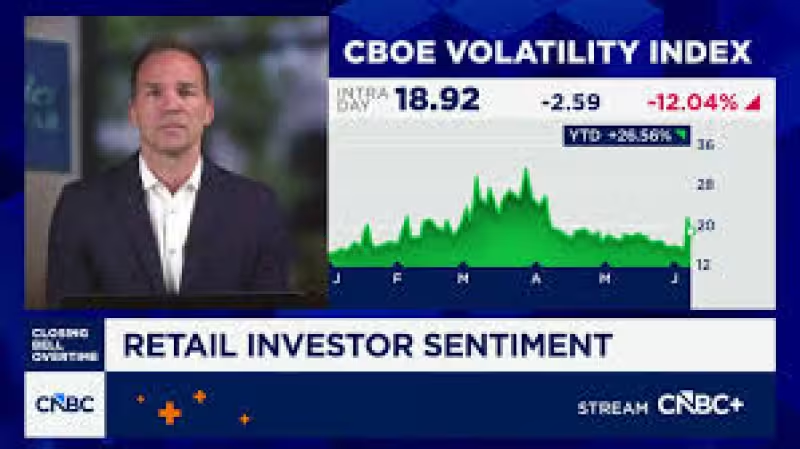
“Another thing that really kind of stood out is just the more adoption of options uh in terms of kind of how investors are are choosing uh to get into the market,” Joe Mazzola, Charles Schwab’s head trading and derivatives strategist, told an interviewer, summing up the firm’s May STAX trading data.
Schwab’s report found retail traders stepping back into AI trade leaders last month and showing heavier use of derivatives—both upside call buying and notable put activity in memory-chip names. Mazzola said the firm saw a decent amount of put selling in high-flying names including Micron and Sandisk, as well as some upside call buying, a mix that let individual investors participate in rallies without holding full equity positions.

The trading picture tightened on headlines. Mazzola pointed out that the S&P 500 reached the 7450 level—the 21-day exponential moving average—before a market-moving social-media post sent the index back to 7200 and change that day. “When the tweets come out, I I think that moves markets,” he said, and he singled out the Middle East situation as having a heavy impact on some of the selling seen.
That combination—an index that held up near its short-term trend while single-stock implied volatilities spiked—was the friction at the center of Schwab’s read on May. Tech names make up roughly a third of the S&P 500, Mazzola noted, so concentrated flows in a handful of AI leaders or chip stocks can push their options implied vols sharply higher even as the broader index shows only a small pullback.



Mazzola tied retail behavior directly to that dispersion. Retail traders were both buying calls—adding to upside gamma in individual names—and engaging in put selling in chips, moves that change how volatility is distributed across stocks. He also said geopolitical risk had climbed to the top of investors’ lists, overtaking inflation as the number one concern for many clients, and that those headlines amplified quick, sometimes large reactions.
The STAX snapshot for May, in Mazzola’s telling, was not a single-day anomaly but part of a broader retail return to the market with a stronger options footprint. The concrete examples Schwab recorded—put selling on Micron and Sandisk, mixed with call buying in AI leaders—illustrate how clients are seeking exposure that isn’t simply owning shares outright. That behavioral shift matters because options activity can change intraday liquidity, skew hedging flows for market-makers, and feed back into stock price moves.
Still, the most consequential unanswered question from Schwab’s data is whether May represents the start of a durable change in retail playbooks or a tactical response to headline risk. If retail customers continue to favor options—particularly short-dated calls and sold puts—markets could see persistent single-stock volatility even when the index itself appears stable.
FilmoGaz has covered other Schwab moments in sports and company news; see Charles Schwab Leaderboard: Six Share Lead at Colonial After Weather Delay, Rickie Fowler interest collides with new PGA TOUR Expert Picks as Charles Schwab Challenge opens, and Gary Woodland Sets Sights on Colonial After Tied-11 Finish at Charles Schwab for context on the brand’s public profile. For market watchers, the immediate signal to watch is the next STAX release and whether options volumes and directional mixes stay elevated—because if they do, selective spikes in implied volatility could keep headlines and tweets moving individual stocks even while the S&P inches along near its averages.