



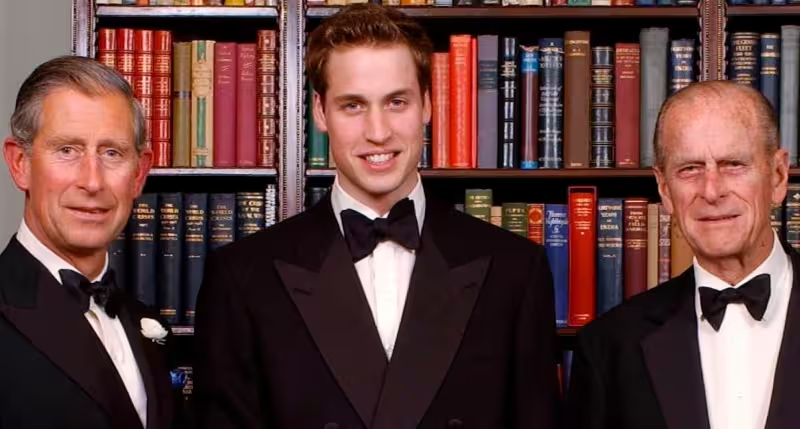
Grant Harrold watched a royal ritual undo itself in real time. "The fact that he is acting like any other football fan, which we would have never seen his grandmother or grandfather do, or even his father, shows how he is relaxing things and a sign of things to come," Harrold told OLBG of William, Prince Of Wales cheering and dancing at matches.
Harrold, who worked for The King for nearly a decade, framed those actions not as small eccentricities but as a deliberate break from long-standing household rules. "When I was there, there were strict protocols we were given if we went into a royal box or an area with the royals, of how you could behave, what you could wear, what you could say, what you could do," he said. That list, Harrold added, once set the boundary between royals and the crowd.

The weight of Harrold’s claim lies in the contrast he draws: "Traditionally, the royals would come in, be greeted, and do their handshakes. Sit there quietly, have a poker face, watching the game, giving no insight into which team they were supporting." By that standard, William’s visible allegiance and unbuttoned joy amount to more than personal taste — they are public signals about how the younger generation of royals intends to behave.
Peter Shilton, the former England goalkeeper, offered the human side of that same signal. "I do genuinely think he loves football, the excitement of it," Shilton said, adding that William "appears so grounded and natural singing in the crowd with his mates." Shilton, whom William presented with a CBE two years ago, said the prince’s involvement "makes the public feel more connected to him" and that he is "a genuine fan and is a true Ambassador of the sport."
Harrold did not describe chaotic abandon; he described choice. "Protocol goes out the window," he said, describing what happens when prince and crowd begin to move in the same rhythm. Harrold’s observation is grounded in specifics: William is often spotted at Aston Villa matches with lifelong friends and sometimes with his son, and last summer he took Princess Charlotte to Switzerland to watch England's women's team lift the UEFA Women's Euro 2025 trophy.
Those onlookers who cheer the change point to immediate returns. Richard Fitzwilliams captured the sentiment in one line: "William finds football absolutely magical." Shilton argued the visibility of a future monarch in the stands is not cosmetic. "It’s incredibly important we as a football loving nation have a future King that so clearly feels the same and makes us all feel more connected to him," he said, adding that William gives players "a massive boost."
Context deepens the picture: for decades, royals attending matches maintained a studied neutrality, a poker face meant to keep public and private roles distinct. Harrold’s account places William’s behaviour inside a broader cultural shift — younger royals choosing less rigid separation from the crowd and, in some moments, stepping into the role of an engaged fan rather than a distant emblem.
Still, the change is not absolute and the gap between gesture and policy is where the story tightens. Harrold says William's behaviour breaks with old royal neutrality, but there is also cautionary distance: no trip to the United States for the World Cup has been confirmed. That unresolved detail matters because the upcoming tournament would be the highest-profile stage yet for visible royal partisanship.
The friction is practical as well as symbolic. Relaxed behaviour in a local stadium is one thing; a high-profile appearance at a global event would carry diplomatic and constitutional implications. Harrold’s memories of protocol and Shilton’s praise of the prince’s authenticity point in the same direction — a monarchy that appears closer to its people — but whether that posture will compute on the world stage remains unsettled.
The next act is simple and specific: will William travel to the United States for the World Cup? It is the question the loosened protocol now raises and the decision that will show whether a handful of celebratory dances at domestic matches amount to a new precedent or remain local, personal gestures. For royal watchers and football fans alike, the answer will tell us whether the trend Harrold described is a gentle evolution or the start of something more formal and permanent.



