



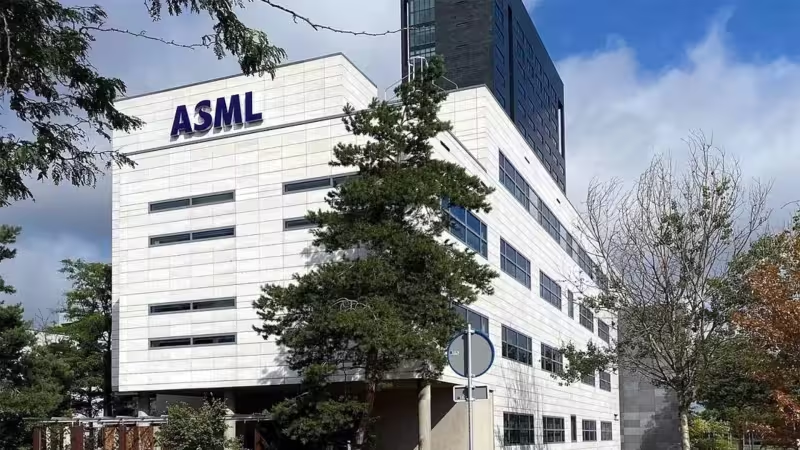
ASML closed Wednesday, June 3, 2026, with a market capitalization of $668 billion, making it the most valuable company in European history.
The jump put ASML past the $650 billion mark set by Novo Nordisk in June 2024 and cemented its place ahead of SAP; the company is now worth more than HSBC and Roche combined. The stock has climbed roughly 50% this year, a surge that helped push the new record but still lags gains across the broader semiconductor sector.

Analysts who bolstered valuation models say the move reflects changed assumptions about how many extreme ultraviolet lithography systems ASML can ship. JPMorgan raised its price target to €1,900 from €1,515 and kept an Overweight rating, while Morgan Stanley lifted its target to €1,660 from €1,400 and also stayed Overweight. JPMorgan analyst Sandeep Deshpande said ASML can deliver more than 110 low‑NA EUV systems without adding new building capacity, a number that exceeds previous investor expectations of roughly 90 units. Morgan Stanley said its greater confidence was driven by comments at ASML's April annual general meeting.



The stock reaction rests on a narrow but critical market reality: ASML is the sole supplier of EUV machines used by TSMC, Samsung and Intel to print leading‑edge logic, and EUV capacity is widely described as a chokepoint for advanced chip supply. The machines are expensive—ASML's low‑NA systems cost roughly $235 million and its High‑NA EXE:5200B about $380 million—and orders and deliveries move industry road maps. Intel installed ASML's High‑NA EXE:5200B late last year for its 14A node, underscoring how tool shipments map directly to foundry and fab plans.
The valuation milestone carries a clear tension. Even at $668 billion ASML remains below the trillion‑dollar market caps some U.S. chip firms have reached, and the company's roughly 50% gain this year has trailed the broader semiconductor group—a reminder that investor enthusiasm for ASML is large but not uniform. The more immediate question is operational: how quickly ASML can scale beyond the roughly 110 low‑NA systems analysts now model. ASML outlined an expansion at the Brainport Industries Campus in Eindhoven at its April meeting, and construction there is set to begin in the third quarter of 2026, but ground‑breaking and ramping production are different things.
Longer term, new or alternative technologies add uncertainty. Start‑ups and incumbents are seeking routes around EUV: Substrate has raised $100 million for a particle‑accelerator X‑ray lithography system it says can pattern 2nm‑class features at roughly $10,000 per wafer, while Substrate models leading‑edge EUV cost at $100,000 per wafer. Canon is shipping commercial nanoimprint tools and Nikon has entered the market with a lower‑end product—factors that keep pressure on ASML's monopoly over the highest‑end machines.
Investors and customers will watch two measurable things next: near‑term shipments and the pace of physical expansion. JPMorgan and Morgan Stanley’s higher price targets assume ASML can lift deliveries; ASML’s own schedule points to Brainport construction beginning in Q3 2026. The single sharp question left by Wednesday’s record close is whether ASML can actually expand output fast enough—beyond the newly modeled 110 low‑NA units—to justify a $668 billion valuation today.



