Palmer Luckey said in Taipei on Thursday that Taiwan should move beyond its role as a global supplier of advanced semiconductors and become a major weapons exporter, arguing that the island could strengthen its security by making and selling completed systems to the rest of the world.
He said Taiwan should not judge its defense market only by its own needs. The ideal outcome, he said, would be a country that exports not just high-end chips but finished weapons systems, and does so at a scale far beyond what it would need for domestic use. Luckey added that Taiwan should be making 10 times more weapons than it needs for itself.

The remarks came during the Computex trade show, where Luckey was asked about how Taiwan could ramp up drone production, how it should do business with China, and how it should deal with Beijing’s practices. He said Taiwan could develop a second defensive shield alongside the island’s much-discussed silicon shield, with defense manufacturing giving other countries another reason to care about Taiwan’s survival and industrial capacity.
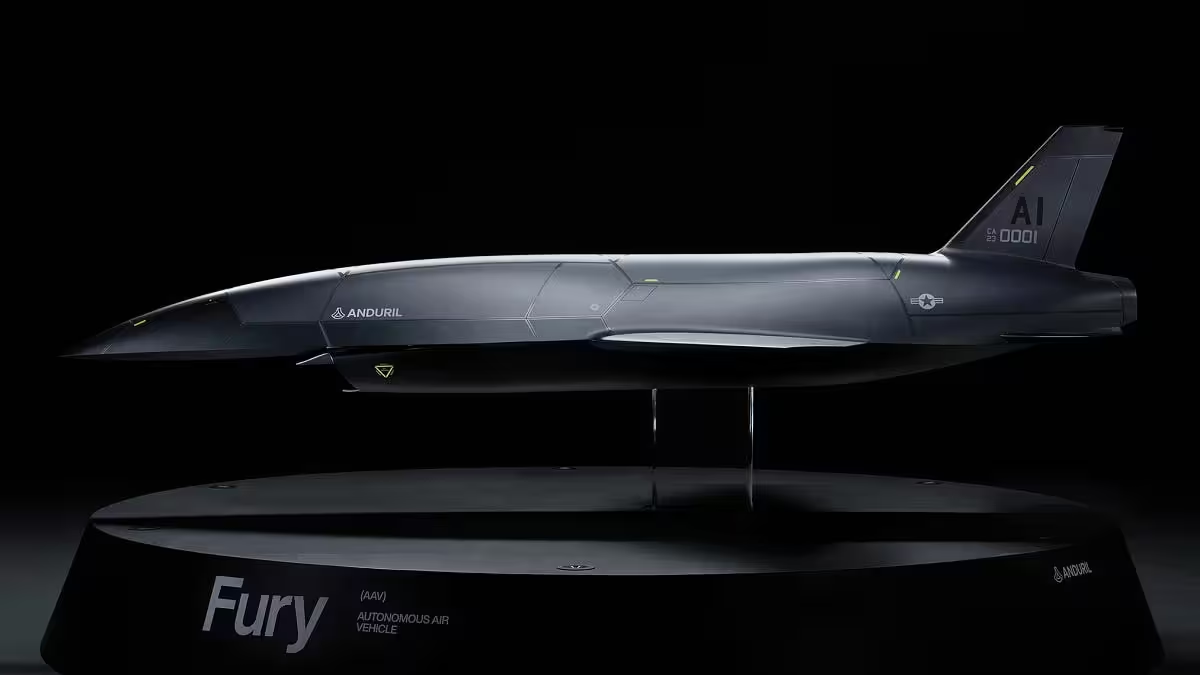

Luckey’s comments go to the heart of a debate in Taipei over whether the island should deepen its role in global defense supply chains even as it still depends on imports for key parts. Taiwan faces a major gap in its domestic supply chain for specialized drone components, including AI imaging modules and flight control systems and modules, and its government has launched an initiative to manufacture critical imported components by March 2027.
That gap sits uncomfortably next to Luckey’s pitch. He said Taiwan does not need to match the PLA Army, or even reach one-hundredth of the size of China’s military, so long as it can stop Chinese forces from crossing the strait, landing in mass and sustaining an occupation. He framed the goal as asymmetric defense, not parity.
Luckey also pointed to Anduril’s own links with the island, saying around 30 Taiwanese companies are now in the company’s supply chains. He said there are things in the world that exist because Taiwan leads in technology, and he does not want that role to disappear. For Taiwan, the open question is whether it can turn that industrial base into a weapons export business quickly enough to matter, while still filling the gaps that leave its own drone industry dependent on outside suppliers.
The timing gives the comments extra weight: Luckey made them in Taipei during Computex, which ended on Friday, and he tied Taiwan’s semiconductor dominance directly to a broader case for strategic dependence. If Taiwan can build the parts it still imports and scale up completed systems for export, the defense argument he laid out could become a business plan rather than just a theory.