



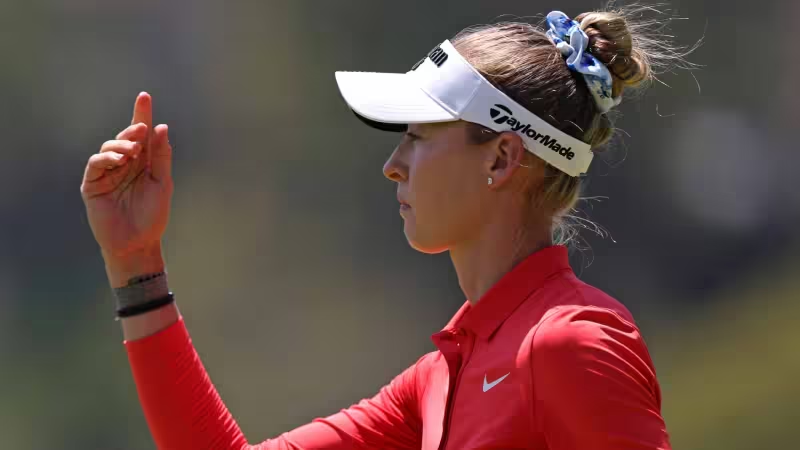
Nelly Korda started the year writing positive notes to herself in her bathroom and now, with Post‑it reminders traveling in her bag, she arrives at Riviera Country Club tied for the lead going into the final round of the 2026 U.S. Women's Open. A late birdie run on Saturday moved her into a share of the top spot and left the World No. 1 18 holes from what would be her first U.S. Women's Open title.
The stakes are immediate and unmistakable: 18 holes separate Korda from a major that has eluded her and, if she completes the job, her victory would break a drought longer than 60 years without an American woman winning the championship. She carried herself to the top with a late push on Saturday and, afterward, said the difference this year has been a change in how she approaches the week.

Korda has been explicit about that shift. She said last year she "really, really wanted it" and that "the more you want it sometimes the more you stiffen up and you get a little bit more nervous." That craving, she said, helped produce frustrating finishes — including a T2 at last year's U.S. Women's Open after faltering on the back nine — and became a problem she wanted to fix rather than repeat.
Her remedy was small and practical. "I started at the beginning of the year writing positive notes to myself in my bathroom," she said. "And I’ve seen a bunch of athletes do that." She described a routine of sticking a Post‑it on the mirror when she gets ready and keeping that week's thought in front of her. "I travel with post‑it notes and I stick ’em on to the mirror when I get ready and I write myself a positive note and that’s my thought for the week," she said.


Korda added that the work has not been solitary. She talked with many people close to her and even leaned on her fiancé, who "always tells me, ‘You need to be a little bit more positive,'" she said. The change was deliberate: "That’s kind of been my attitude this year is like no matter what it throws at me, if I’m just going to get a silly bounce here or there I’ll end up in a divot like I’ll figure it out…"
Still, the old instincts remain — and they matter now. "Because I think the worst thing that you can be, but which I am still, is a perfectionist in this sport," Korda said. She acknowledged that wanting a title too much can make a player rigid, a friction she must overcome over 18 closing holes at Riviera. The late birdie run that put her in position on Saturday was proof her game can produce under pressure, but it did not erase the memory of how tournaments have slipped away when the margin thinned.
The context is clear: Korda's season-long run of form is inseparable from the mental work she has done, and her routines are now on full display with the biggest prize in American women's golf within reach. The Riviera test on Sunday will not only be a measure of her swing and short game but of whether a week of sticky notes and a conscious effort to loosen can quiet the nerves that dogged her in previous big moments.
What happens next is simple on paper and complicated in practice. Korda will tee off for the final round with the lead in hand; she must translate the mindset she has rehearsed into one clean, composed 18‑hole stretch. If she does, she will claim her first U.S. Women's Open and end a more than 60‑year wait for an American woman. If she cannot, the question that hangs over Riviera is the same one she posed for herself this year: will the person who still admits to being a perfectionist be able to relax enough to finish?



