
If you want to know how to reduce screen time, the clearest, immediate step experts offer is simple: treat phone use as a choice rather than an automatic habit. Make a conscious decision before you unlock the screen, and use available software or hardware tools to support that choice—those two moves are the backbone of the practical advice designed to cut down doomscrolling.
The problem has begun to land outside clinics and living rooms. In March, Meta and YouTube paid a combined $6m after a U.S. court found their platforms were designed to be addictive, a concrete legal recognition that the mechanics inside apps matter to anyone trying to spend less time online.

The mechanism behind that pull is straightforward and familiar to addiction researchers. "We’ve outsourced our brain to California – our emotions, our thinking," Prof Marcantonio Spada says. He draws a through-line from his earlier work on alcohol and nicotine to technology: "I started my career in academia researching alcohol and nicotine, and then I came to realise 15 years ago that we would end up having a bigger problem with technology." Spada adds that platforms offer intermittent rewards—funny videos, followers, notifications—that deliver "positive and negative reinforcement, exactly like alcohol does," and they keep the brain in a state of ongoing anticipation.
That anticipatory state helps explain why people who pick up a phone to feel better often end up feeling worse. Therapist Hilda Burke recalls that "about seven or eight years ago, it started coming up as a topic a lot in my individual work and in couples work: phones causing relationship issues, mental health issues, sleep issues, concentration issues." The scrolling may blunt discomfort for a moment, but "the original problem people were trying to self-medicate was still there after four or five hours of scrolling," she says. "But now on top of that, we’ve got the hangover from the scrolling, which is: 'Why did I waste that time? What am I doing?'"


Those two realities—apps engineered to keep attention and scrolling that fails as a lasting cure—point straight to the actionable counsel clinicians repeat. Burke’s central instruction is compact: "What I try to do with my clients is to make it conscious, to choose what you’re doing." She demonstrates the habit herself: "I chose to go on Instagram – I wanted to see Brooklyn Beckham and what people are saying about that. I wanted to spend two hours really doing a deep dive." The decision to open an app with purpose, she argues, changes the result.
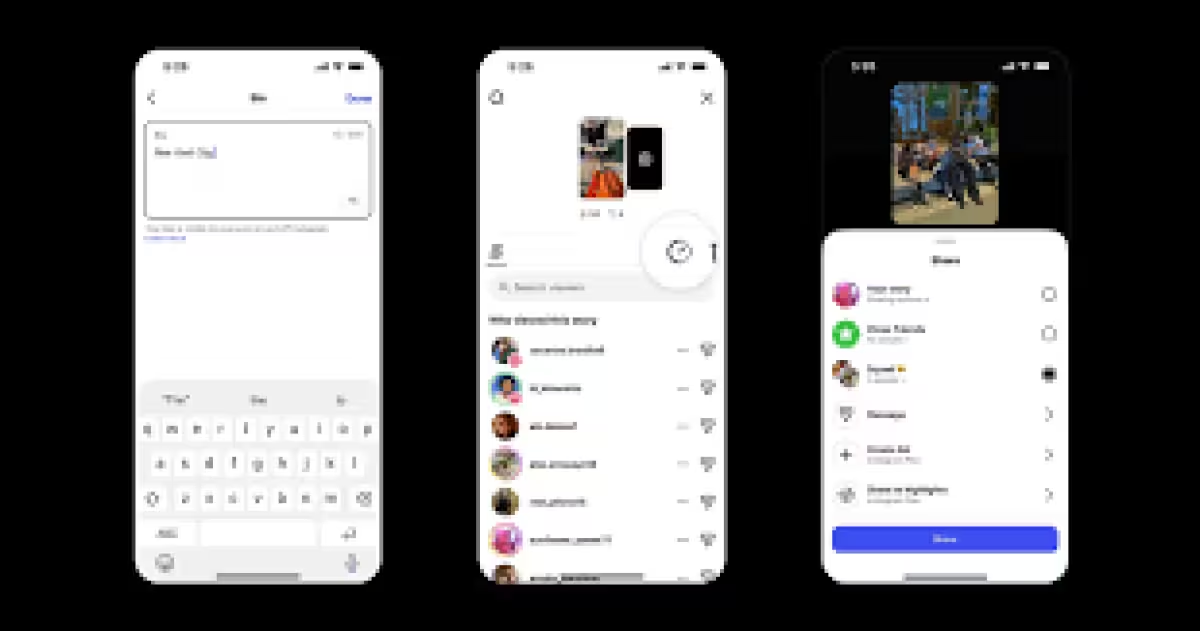
Practical moves fall into two linked categories: psychological framing and tooling. On the framing side, name the urge when it comes, notice whether you’re trying to soothe something unresolved, and set a clear intention before you open an app—decide what you want to find or how long you will stay. On the tooling side, use the apps and hardware that have been developed to help people rethink device time: timers, notification controls and features that limit or reframe usage can make the conscious choice easier to keep.
Understanding the pull matters because it alters the experiment. Knowing that intermittent reinforcement drives checking makes a simple test more informative: try a brief, repeatable habit—decide on a purpose, time-box the session, and compare how you feel afterward to the typical anonymous scroll. Clinicians and designers both point to deliberate experiments rather than moralising about screens; the goal is to replace automatic scrolling with a pattern you can repeat.
The single, unresolved question is not moral but empirical: which specific behaviour changes and which specific tools reliably reduce compulsive scrolling over weeks and months? Courts have begun to treat design as part of the problem and clinicians point to conscious choice as an immediate remedy, but the evidence on which routines produce lasting change is still thin. If you are trying to reduce screen time today, the most defensible course is to combine intention with tools and treat the first few weeks as a test of what actually sticks.