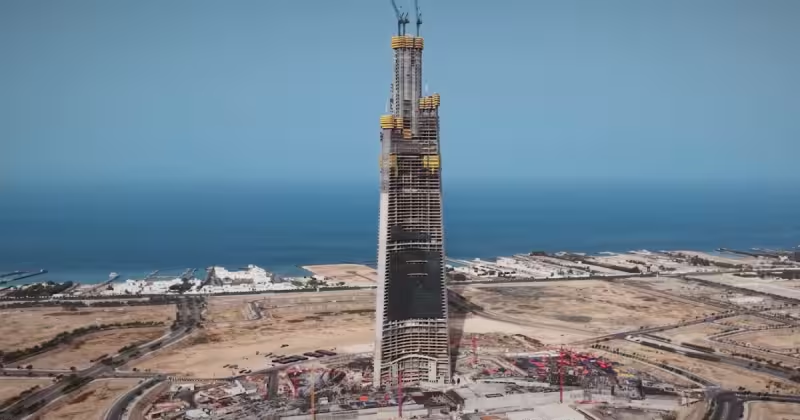
JEC Tower in Jeddah has reached 102 floors, a construction milestone that pushes the project past the 100-floor mark and advances its bid to top out at more than 1 kilometer.
The climb places the tower among roughly 25 buildings worldwide to exceed 100 floors and moves it toward a planned height that architects Adrian Smith + Gordon Gill say will include at least 157 floors and surpass the 828-meter Burj Khalifa. At a projected 1,008 meters, the JEC Tower would also stand nearly twice as tall as One World Trade Center, which is 541 meters.

Inside the supertall shell, designers plan the world's highest observation point plus a luxury hotel, office space and apartments. Structurally, the project relies on a concrete-based system developed with Thornton Tomasetti; the firm has argued that “Concrete is king in the Middle East” and that the design leverages regional construction practices. The tower sits on a 5-meter-thick raft foundation supported by 270 bored piles, each 1.8 meters in diameter and extending to depths of up to 105 meters.
The milestone follows a recent surge in activity: construction first began in 2013, reached 69 floors in November last year, and has accelerated in recent weeks to push past 100 and on to 102 floors. The project sits at the center of a new urban development in Jeddah and is being tracked closely because its finished height would place it at the top of lists of the world's tallest buildings.
That forward motion, however, sits atop a complicated record. Work on the tower was suspended in 2018 and restarted only in early 2025, which helps explain the stop-start rhythm observers have noted. The interruption complicates any simple projection of how quickly the remaining floors will rise; a supplementary report also notes that Jinggong Steel International won the bid for the main steel-structure works planned above the 120th floor, signaling a planned transition in construction materials and methods as the tower climbs.
The near-term consequence is clear: crews have moved the needle again and are now working through the next hundred or so floors that separate them from the building's 157-floor minimum. The unknown that will determine pace and cost is precisely when teams will complete the concrete-led lower stack and hand off to the steel superstructure above the 120th floor, and how that handoff will affect the rhythm of work.
Project documents and public statements set a target completion in 2028, but they do not publish a firm schedule for each phase between today’s 102nd floor and the final crown. The single most consequential unanswered question now is when builders will hit the 120th floor and begin the steel phase that will set a verifiable timetable to a more-than-1-kilometer finish; until that switch is publicly scheduled, the 2028 target remains conditional even as the tower climbs.