



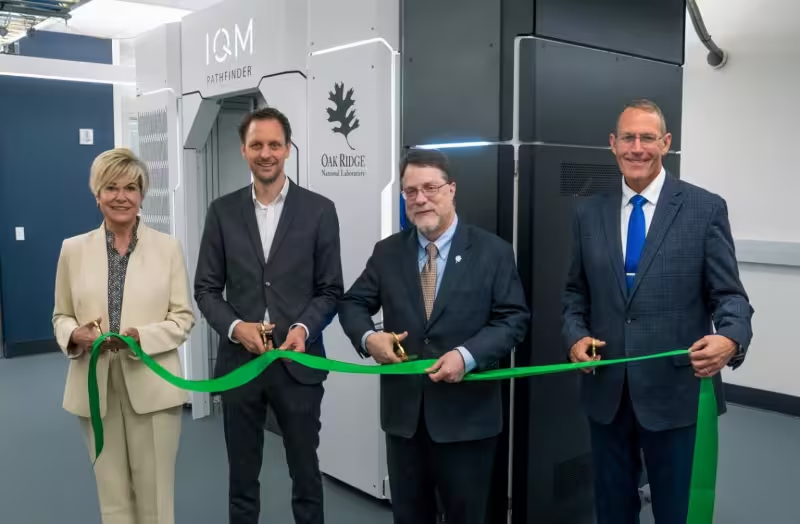
IQM Quantum Computers has deployed Pathfinder, a 20-qubit IQM Radiance system, at Oak Ridge National Laboratory, placing the commercial quantum computer directly inside the lab’s high-performance computing environment and alongside the Frontier supercomputer.
The installation makes Pathfinder ORNL’s first commercially procured quantum computer and gives the lab’s Tech Integration Group direct, on‑site access to the hardware. That proximity lets ORNL engineers and researchers build and test low‑latency, hybrid quantum‑classical connections between Pathfinder and Frontier, the system described as the world’s most powerful supercomputer for open science. IQM has previously finalized sales of 23 full‑stack quantum computers and launched a U.S. Quantum Technology Center in Maryland’s Discovery District ahead of this deployment.

Numbers underscore the move: Pathfinder is a 20‑qubit device; IQM has completed sales of 23 full‑stack systems; and the company’s planned public listing via a business combination values IQM at a $1.8 billion pre‑money equity valuation. Those figures frame the commercial scale behind a machine now embedded inside a Department of Energy laboratory and tied into an established HPC ecosystem rather than residing behind a remote login.



ORNL research teams will use the on‑premises co‑processor to develop unified, system‑level software tools and hybrid workflows aimed at advanced materials simulations, molecular chemistry and hardware‑accelerated artificial intelligence. With Pathfinder physically housed on site, scientists can iterate software and hardware together and experiment with system‑level integrations that are difficult to reproduce when a quantum device is accessed only via remote cloud interfaces.
The deployment also highlights a structural difference in how quantum hardware reaches users. IQM’s on‑premises model places the device under the lab’s immediate control and allows tight coupling with Frontier and ORNL’s HPC stack. That contrasts with cloud‑only access patterns where manufacturers retain physical custody of machines and users interact over networked sessions. The hands‑on arrangement at Oak Ridge promises lower latencies and deeper integration, but it also shifts maintenance, operational workflows and some integration burdens onto the lab rather than the supplier.
The announcement leaves a key operational gap: the installation does not include a start date for research runs or identify which specific projects will be first to use Pathfinder. ORNL has said the system will support development of hybrid quantum‑classical workflows, yet the timetable for producing research results or demonstrating performance gains remains unspecified. For a lab that now houses both Frontier and an on‑site quantum co‑processor, the immediate question is which experiments ORNL will prioritize and when those hybrid workflows will begin yielding measurable outcomes.



