



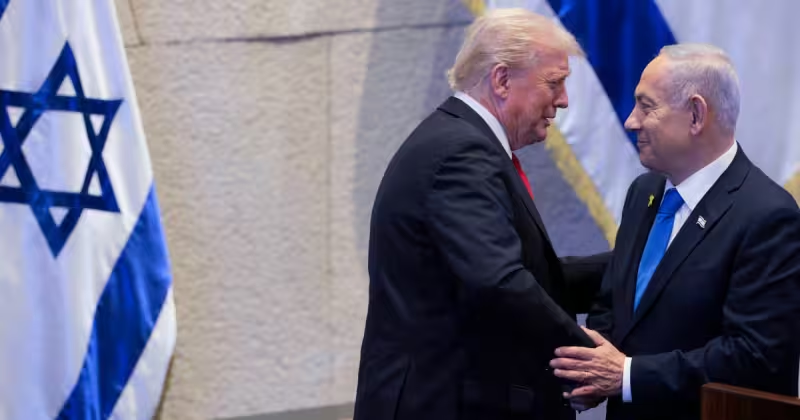
The Pentagon’s Defense Intelligence Agency has raised Israel’s counterintelligence threat level to the highest classification — “critical” — in a message circulated internally in recent weeks, marking an abrupt escalation in US Israel intelligence tensions.
Two current U.S. officials and one former U.S. official said the DIA issued a seven-page assessment, complete with a chart, that concluded Israel’s ability to conduct human espionage and technical collection is at a “critical level.” Officials told FilmoGaz the designation reflected mounting concern that Israel was making a particular effort to surveil top U.S. officials and to seek information on the Trump administration’s internal deliberations and decision-making about conflicts in the Middle East.

The change, officials said, was issued in recent weeks and was not a routine update: the document reportedly identified a series of specific incidents that heightened U.S. concerns and described recent collection as going well beyond what is typical or expected between allies. One current official said the assessment included a chart and ran seven pages; another described the concerns as focused on both human and technical collection targeting senior American decision-makers.
Those concerns land against an already strained policy backdrop. The United States and Israel launched the war with Iran on Feb. 28; a ceasefire went into place in early April, after which the U.S. began pursuing a diplomatic deal to end the conflict. Israeli leaders have been publicly skeptical about Iran’s willingness to adhere to any negotiated settlement, and Prime Minister Benjamin Netanyahu has pushed to resume bombing raids. President Donald Trump has pressed Israel to scale back attacks against Hezbollah in Lebanon; officials said Israel is keenly interested in whether Trump resumes major combat operations against Iran or moves to end the fighting. This policy rift, U.S. officials said, helps explain why U.S. analysts flagged intensified collection directed at internal American deliberations.
The report’s findings have not gone uncontested. A spokesperson for the Israeli embassy in Washington, D.C., called the notion that Israel spies on the United States “completely false,” adding, “Israel does not gather intelligence on American entities, let alone US government officials,” and “Israel intelligence collection efforts are aimed at its enemies, not its allies.” The spokesperson also said, “Any claims to the contrary are either misinformed or politically motivated.” A White House official issued a firm denial as well: “This entire story is false and sourced to someone who doesn’t have any knowledge of what’s going on.” The Office of the Director of National Intelligence did not respond to a request for comment.
The friction is sharp because allies regularly collect intelligence on one another; what U.S. officials say changed was scale and focus. The current and former U.S. officials told FilmoGaz they viewed Israel’s recent efforts as exceeding typical intelligence activity between partners, a judgment that propelled the DIA assessment. At the same time, officials acknowledged gaps: they said they did not know whether a single, discrete incident triggered the decision and that the document they described lists multiple episodes without singling out one definitive provocation.
The immediate consequence is internal: the Pentagon’s new designation signals heightened concern inside the Defense Department and marks a rare public step in an intelligence relationship usually managed quietly. It places a spotlight on whether Washington will alter handling of sensitive information or adjust counterintelligence posture in ways that could ripple through cooperation on the Middle East. For now, however, the precise incidents the DIA identified remain the central unknown.
The single most consequential unanswered question is straightforward and urgent: what specific incidents did the seven-page assessment cite to justify elevating Israel’s counterintelligence threat level to “critical,” and will those incidents prompt changes to the rules that govern U.S.-Israel intelligence sharing? Officials have published the classification inside the Pentagon; whether they will brief Congressional overseers, alter operational ties, or make the underlying evidence public is the next development to watch.



