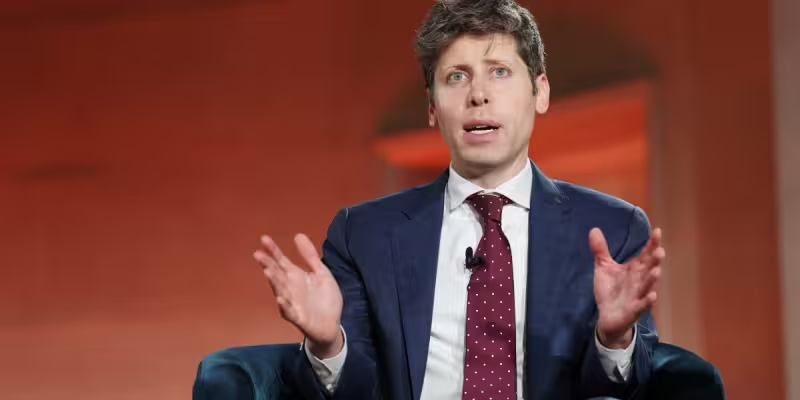
Dario Amodei joined Sam Altman and Mustafa Suleyman in signing a public letter to Congress that calls for legally required screening and recordkeeping for companies that sell synthetic DNA and RNA.
Organized by the Foundation for American Innovation and the Institute for Progress, the letter asks lawmakers to mandate that firms selling synthetic materials screen orders and keep detailed records of what they ship, including exact specifications of the materials. It frames the request as a narrow, industry-wide rule designed to limit the risk that dangerous biological material could reach bad actors.

The letter makes the case in blunt terms: "AI systems are improving rapidly, and alongside incredible benefits to science and medicine, there is a real possibility that the knowledge barriers which have historically prevented bad actors from obtaining biological weapons will meaningfully erode." Dozens of experts in the life sciences and national security fields added their names to the appeal.
Among the commercial signatories are companies that manufacture synthetic DNA and RNA. Twist Bioscience and Ansa Biotechnologies are listed as signatories, a fact that highlights the practical reach of the proposal: the rules it asks Congress to write would apply to exactly the kind of firms that already screen some orders voluntarily.
That voluntary screening is central to the letter’s pitch. It acknowledges existing industry practices while pressing Congress to convert them into uniform, legally enforceable requirements — mandatory checks on customers and mandatory recordkeeping on orders and material specifications. The difference, the letter implies, is enforceability and consistency across all sellers.



The timing is explicit. The letter points to rapid changes in computing and information access, and outside studies bolster that point. A Stanford University study earlier this year found generative AI tools reached 53% of the world’s population in three years. And a report earlier this month found that publicly available AI models can provide substantive information on how to create and spread biological weapons.
Those developments are why the signatories say the old barriers to biological weapons may be crumbling. The authors warn that as machine intelligence advances, the knowledge gap that has long limited misuse of biological materials could narrow, increasing the importance of controls on the physical materials that enable biological attacks.
The letter also contains an internal tension: several manufacturers that would be directly regulated by the requested law signed the appeal even though it would make screening and recordkeeping legally mandatory across the industry. That includes the two named companies and other commercial actors whose current voluntary checks would become statutory obligations if Congress adopts the proposal.
Signers underscore that biological attacks have been rare historically — a study in The American Journal of Emergency Medicine places biological agents at 0.02% of all historical attacks — but they argue rarity does not eliminate catastrophic potential. The letter further notes the United States already criminalizes development or possession of biological weapons under the Biological Weapons Anti-Terrorism Act of 1989, and the new measures would aim to add a layer of prevention focused on supply chains for synthetic materials.
The immediate consequence is political: lawmakers now have a concrete, expert-backed request for statutory change. The letter sets out specific obligations for screening and recordkeeping, and it brings together high-profile AI executives, life-science specialists and some industry suppliers on a single prescription. What it does not do is set a timetable or guarantee congressional action.
Congress must decide whether to translate voluntary company practices into mandatory federal law. The letter puts the choice squarely before legislators: require uniform screening and detailed recordkeeping across all sellers of synthetic DNA and RNA, or leave those protections to a patchwork of voluntary industry policies. Which path lawmakers take — and how they would enforce new rules if they adopt them — remains the unanswered, consequential question hanging over this policy push.