




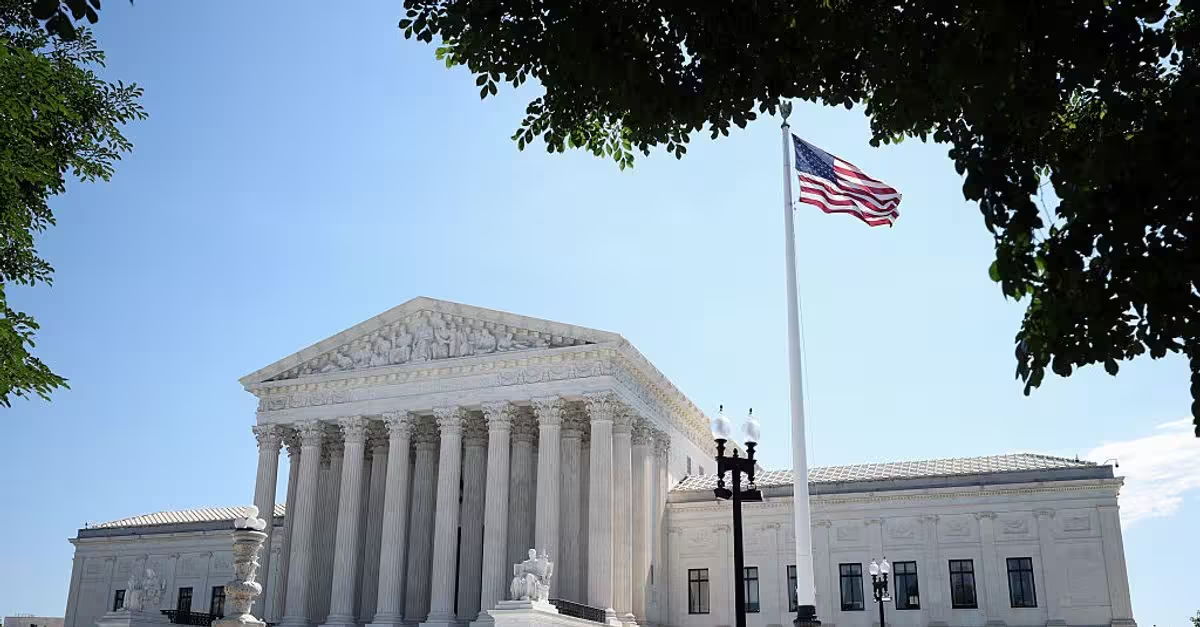
The US Supreme Court on Thursday upheld the Federal Communications Commission’s system for levying in-house fines, ruling 8-1 against AT&T and Verizon in a case that tested whether agency proceedings strip companies of their constitutional right to a jury trial.
Chief Justice John Roberts wrote the opinion for the court, which backed the FCC’s assessments of roughly $57 million against AT&T and nearly $47 million against Verizon — part of nearly $200 million in penalties the agency imposed on carriers for allegedly selling customer location data without users’ consent. Roberts wrote that the agency orders did not, in themselves, create an obligation to pay.

The decision preserves a major enforcement tool for the FCC. The agency also fined T‑Mobile $80 million and Sprint $12 million in the same sweep; Sprint was acquired by T‑Mobile in 2020. Verizon and AT&T paid the fines and then challenged the agency’s internal process, a dispute that produced conflicting rulings in regional appellate courts and landed at the Supreme Court.
The Justice Department told the court the FCC’s assessments are not binding and do not block later litigation, arguing that if the government elected to bring an enforcement action in federal court the carriers could press their defenses before a jury. The Supreme Court accepted that framing, saying the FCC’s in-house findings do not settle the carriers’ legal obligations and thus do not foreclose subsequent judicial review.
The carriers framed the case differently. AT&T and Verizon argued the FCC’s internal process effectively adjudicated matters that belong in court, denying them a jury and inflicting reputational harm before any judicial determination. That conflict — between an agency’s need to police telecom practices and a company’s constitutional protections — is at the heart of the ruling.
Justice Clarence Thomas was the lone dissenter. The court’s split follows a broader line of litigation over agency adjudication after the Supreme Court last year curtailed similar in-house proceedings at the Securities and Exchange Commission. This case tested whether the FCC’s approach survived that new boundary, and the majority concluded it did when the assessments leave the door open to court actions.
The practical result is immediate: the FCC keeps a tool that produced nearly $200 million in penalties across major carriers, and those prior fines stand. But the ruling stops short of a bright-line rule for all agencies — the court emphasized the nonbinding nature of the FCC’s orders as the key limit, and it accepted the Justice Department’s assurance that juries remain available in later enforcement suits.
The most consequential question now is how lower courts and other federal agencies will read the decision. Will regulators view the opinion as a green light to revive or expand in-house enforcement, and will judges police the boundary the majority described when a later civil suit seeks damages or penalties in court? The Supreme Court preserved the FCC’s power today; it left unsettled whether that power will grow, or how far agencies may push internal adjudication before running afoul of the jury-trial right.



