



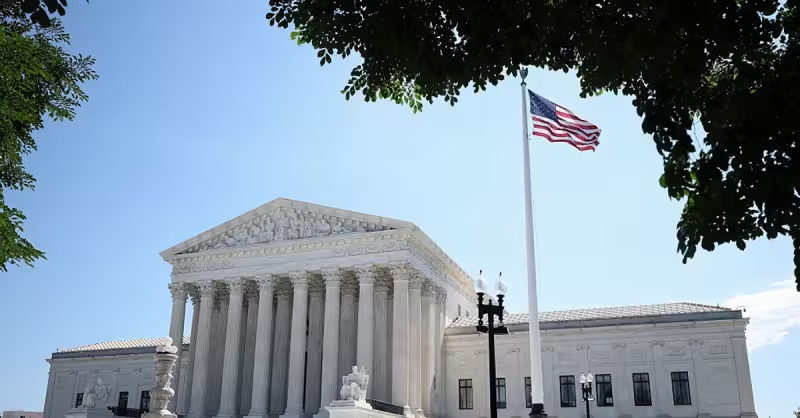
The Supreme Court on Thursday rejected AT&T and Verizon’s constitutional challenge to the Federal Communications Commission’s sanction process, ruling 8-1 in FCC v. AT&T and preserving the agency’s ability to issue forfeiture orders without an immediate jury trial. Chief Justice John Roberts wrote the 14-page opinion for the Court; Justice Clarence Thomas was the lone dissenter.
The case centered on two large penalties the FCC assessed for mishandling confidential customer location data — $57 million against AT&T and $47 million against Verizon. Roberts said the Commission’s forfeiture orders do not themselves require payment and therefore do not trigger the Seventh Amendment right to a jury trial at the agency stage. Instead, he wrote, a forfeiture order is the Commission’s own determination that only enables the Department of Justice to file a suit to recover for the suspected violations, at which point a jury could decide factual disputes.

Roberts framed his holding around the Seventh Amendment’s protection of trial by jury in “suits at common law,” and he explained that the Constitution guarantees a party the opportunity to insist that a jury make the ultimate determination of issues of fact before legal rights and obligations are conclusively settled. He concluded that the FCC’s process fits comfortably within longstanding precedents that distinguish agency determinations from lawsuits that must be tried to juries.


The legal path that produced the Supreme Court review was fractured. AT&T and Verizon both sought review in the federal courts of appeals rather than waiting for any DOJ enforcement suit. The cases split: the U.S. Court of Appeals for the 5th Circuit sided with AT&T and threw out the FCC’s order, while the 2nd Circuit ruled against Verizon. The split set up the present high court showdown over whether the companies were entitled to a jury before the FCC could issue its forfeiture orders.
The friction in the case was explicit. AT&T and Verizon argued that the FCC’s orders inflicted immediate reputational and practical harms that should entitle them to a jury trial; the carriers pointed to the millions in penalties and the serious business consequences that follow from an agency finding of wrongdoing. The Court responded that the Seventh Amendment applies to suits with a value in controversy — a threshold the framers set at more than twenty dollars — and that the mere issuance of an agency forfeiture order, standing alone, does not constitute the kind of suit that demands a jury’s verdict. Roberts emphasized that, at day’s end, the Commission’s order does not itself force payment; the government must prove its case to a jury in federal court to recover the fines.
The ruling preserves the FCC’s enforcement architecture but leaves open the practical question that matters most now: will the Department of Justice bring a civil suit to collect the $104 million in combined penalties? The Court pointed to that statutory enforcement path as the place where jury rights attach, and it left intact lower-court review routes. Carriers may press deferential review in the courts of appeals, or they may wait to see whether the FCC asks the DOJ to sue; the opinion noted both options.
The most consequential unanswered question after Thursday’s decision is whether the government will move to convert the Commission’s findings into a federal-court action and force a jury to resolve disputed facts. The Court has cleared the constitutional hurdle that AT&T and Verizon raised; the next fights will be procedural and tactical — appeals on the record the FCC made, or a new suit in federal court in which the companies would have the opportunity Roberts said the Constitution preserves.



