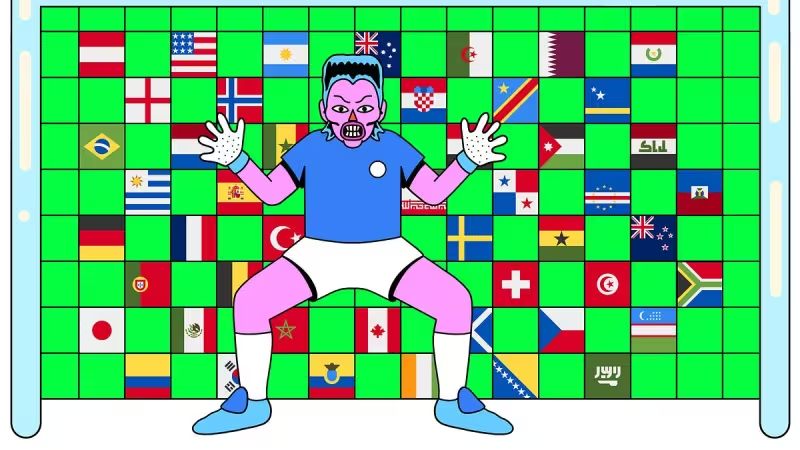
Silver Bulletin has published a live forecast page that projects every world cup games and every stage of the 2026 tournament using 100,000 simulations, and it says the page will be updated frequently as results, tiebreakers and injuries arrive.
The timing matters: Mexico is scheduled to open the tournament against South Africa on June 11, and Silver Bulletin positioned the page as a running map of how an expanded field of 48 teams could unfold across group play and knockout rounds.

At the center of the forecast is PELE, the outlet’s new international soccer rating model launched last month. Silver Bulletin says PELE blends features of its prior SPI model with player market values, an algorithmic Tilt rating for teams, and explicit calculations of home‑field advantage; it also said the team ran PELE back to the first World Cup in Uruguay in 1930 to test historical performance.
The model’s output is probabilistic: every tournament path was simulated 100,000 times to produce win probabilities and match odds for all 48 teams and what Silver Bulletin called “48 stories” across the event. The site also said its baseline PELE ratings are adjusted when algorithmically calculated rosters differ from official announced squads, and that those adjustments correct for injuries or otherwise unexpected player absences.


Silver Bulletin’s forecast notes a split between markets and model output. In prediction markets France and Spain sit as co‑favorites at roughly 17 percent each; Silver Bulletin also lists defending champion Argentina, England, Brazil, Portugal and others as carrying measurable win probability. But the bulletin cautioned that PELE does not place teams in exactly the same order as conventional wisdom or the markets, leaving a different pecking order emerging from the simulations.
The bulletin put that divergence in a historical frame: when PELE’s retrospective ratings are applied to prior tournaments, favorites went 8‑3 in the first 11 World Cups it examined, but only 3‑8 since then. It also highlights a few milestones — for example, Argentina beat the Netherlands 3‑1 in extra time in the 1978 final in Buenos Aires, and the last pre‑tournament number one to actually win was Spain in 2010 — as reminders that pre‑tournament ranking is an imperfect predictor.
The practical consequence for fans and analysts is twofold. First, the page gives a single place to watch how probabilities shift after every match result, every tiebreaker scenario and every roster change; Silver Bulletin said it will update the forecast regularly to reflect those inputs. Second, because PELE incorporates market‑value and home‑field adjustments and then corrects for announced rosters and injuries, its odds can move differently and sometimes sharply from headline market percentages as the tournament unfolds.
The unresolved question the page sharpens is straightforward: if markets list France and Spain as co‑favorites, which team will PELE favor once rosters settle and play begins? Silver Bulletin made clear the answer is not final — the model will rerun as match results arrive — so readers who want to know which side PELE ultimately places on top will need to follow the live page as the opening matches and early surprises reshape the simulations.