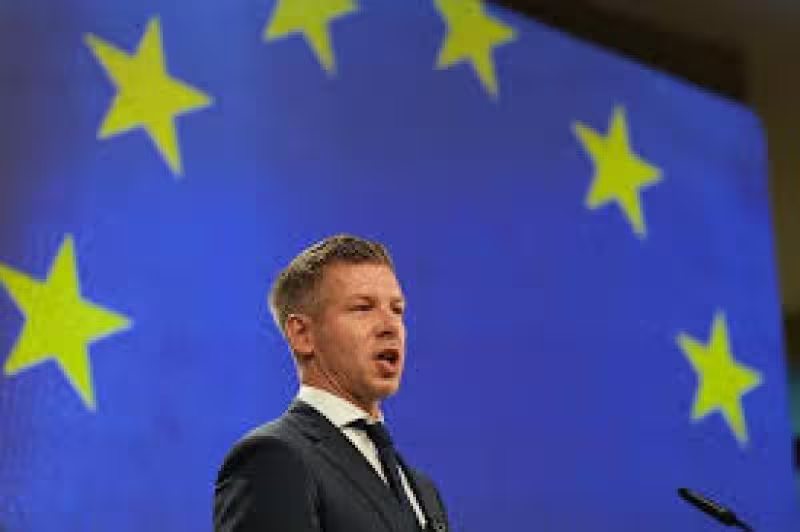
The European Union has decided to unlock billions in funding for Hungary following a series of rapid reforms by the country's new leader, Peter Magyar, EU officials said Friday.
Peter Magyar addressed the media at EU headquarters in Brussels on Friday, May 29, 2026, after the decision was announced, putting the prime minister at the center of a swift break in relations that had previously constrained Budapest’s access to bloc money.

The use of the word “billions” marks this as a large-scale funding release; it signals that Hungary will regain access to significant European Union resources that had been restricted before Magyar’s takeover and the pace of policy change that followed.
Officials tied the move directly to the rapid reforms instituted by Magyar, linking the funding decision to the political changes in Budapest rather than to a routine budgetary transfer. That connection is the central fact: reforms by Hungary’s new leadership prompted the EU to change its stance on blocked funds.
What remains unclear — and is central to the development — is the precise amount being released. The decision is described only as unlocking “billions,” and the exact figure has not been specified in the material made public so far. That omission leaves lawmakers in Budapest and Brussels, as well as analysts and citizens, without the basic metric needed to measure the fiscal and political weight of the move.

For Hungary, the immediate effect is straightforward: the country stands to receive substantial European Union funds it had previously been held back from accessing. The scale of that access will shape domestic budgets and any programs tied to EU financing, but how large the impact will be depends on the sum the EU has chosen not to name publicly.
The timing matters. Friday’s announcement came at EU headquarters in Brussels, where Magyar spoke to the media the same day, highlighting that the reversal was linked to a recent and rapid change in Budapest’s policies. The association between reform steps and the funding decision makes this a targeted political response rather than a routine administrative action.
The gap in disclosed information is the practical tension in the story: an affirmative move by the EU has been announced, yet basic fiscal detail is missing. That gap complicates any immediate assessment of consequences. Without the exact figure, commentators and officials must weigh a broad claim of “billions” against no hard number, and that uncertainty will shape political debate in Hungary and reactions across the bloc.
On the operational side, the announcement implies further steps will be necessary to translate the decision into cash flows — formal confirmations, schedules and possibly implementing guidance from EU bodies — but no additional procedural details have been released alongside the funding unlock. The public record currently contains the linkage between reforms and money and the fact of Magyar’s Brussels appearance; it does not contain the next administrative moves or a timetable for disbursement.
The single most consequential unanswered question now is simple and concrete: how many billions? The size of the release determines whether this is a symbolic easing or a material change in Hungary’s fiscal position. Until the EU publishes the exact amount and any conditions attached to the funds, the practical effects of Friday’s decision will remain speculative.
Friday’s reversal nevertheless resets the political status between Brussels and Budapest. Magyar’s presence at EU headquarters and the explicit tying of funds to his reforms mark a rapid reversal from the previous impasse. The next development readers should watch for is the disclosure of the sum and the administrative steps that will turn the EU’s decision into payments to Hungary.