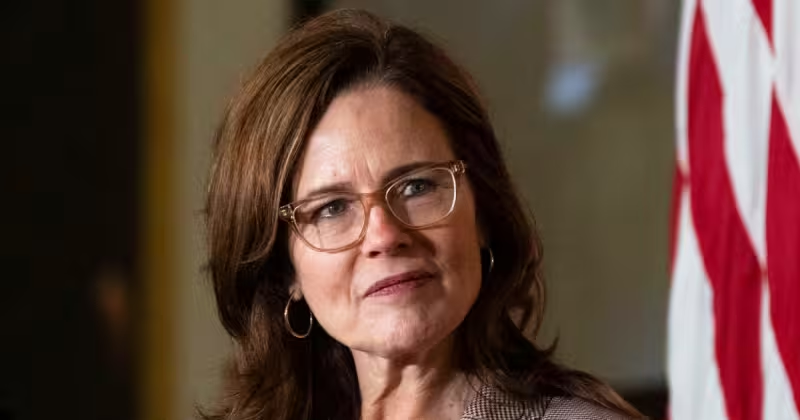
Police responded Wednesday evening to a swatting call at the Virginia residence of Supreme Court Justice Amy Coney Barrett and quickly determined the report was false. Fairfax County police said the call came in through the department’s nonemergency line just after 9 p.m. ET, and officers coordinated with Supreme Court Police assigned to the home.
A Fairfax County police public information officer said, “Yesterday evening at approximately 9:02 p.m., officers responded to a swatting call at the residence of U.S. Supreme Court Justice in Fairfax County,” while county police later said, “Officers immediately coordinated with Supreme Court Police personnel assigned to the residence and quickly determined that the report was fictitious. No additional police resources were utilized.” A dispatcher on audio obtained by NBC Washington said a caller reported hearing gunshots at Barrett’s address in Fairfax County, adding that it was “Unknown if it’s going to be a swatting situation or not,” and noting that the residence has 24-hour security because it belongs to a high-priority county resident.

Barrett was on the bench Thursday morning for decisions. The incident lands in a week when security around the court is once again in focus, not because of what happened at the home but because of how quickly a false report can force armed officers, court police and dispatchers to react to a possible attack on a sitting justice.

Sen. Mike Lee, a Republican from Utah, called the episode an attempt to get someone killed. “Swatting is an attempt to get an innocent person killed—in this case, a sitting Supreme Court Justice,” he said. “The proper response will be putting the offender in prison for many, many years.” His comments came as the court and federal judges face a stubborn pattern of threats that has outlasted the public outrage surrounding each new case.
That backdrop is not new. In 2020, President Donald Trump appointed Barrett to the Supreme Court. Two years later, protesters gathered outside conservative justices’ homes after the leaked Dobbs draft opinion, and Barrett’s home was later described as having been targeted by activists. In March 2025, Barrett’s sister, Amanda Coney Williams, was the target of a bomb threat at her home in Charleston, South Carolina. And in October, a woman was sentenced to eight years in prison after pleading guilty to attempting to assassinate Justice Brett Kavanaugh.
Chief Justice John Roberts wrote in his 2024 annual report that threats against judges had tripled over the last decade, and the U.S. Marshals Service reported 564 threats against judges in fiscal year 2025. The Barrett episode fits that pattern: no one was hurt, no extra police resources were needed, and the report was exposed as fake before it could turn into something worse. The question now is not whether the threat was real. It was not. The question is whether the growing flood of threats against judges will produce consequences severe enough to make the next caller think twice.