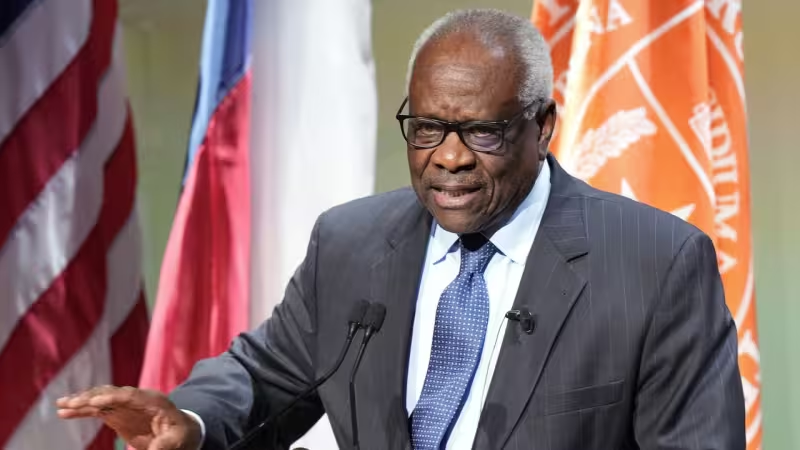
Clarence Thomas told a University of Texas at Austin audience earlier this month that the government is not the source of basic rights, using a public speech to restate the constitutional philosophy that has defined his time on the Supreme Court. The 77-year-old justice, who became the second-longest-serving Justice in history earlier this month, said, “None of our rights come from the government.”
Thomas spoke at the invitation of the university’s new School of Civic Leadership, a program built as part of a wave of conservative-inflected entities being created at public universities in Republican states. He said, “It is the Declaration that announces the ends of government,” and added that “the Constitution achieves this purpose by protecting our natural rights and our liberties from concentrated power and excessive democracy.”

The remarks landed as Thomas extended a milestone that had belonged to John Paul Stevens, who retired after thirty-four years in 2010. If Thomas remains on the bench until May 20, 2028, he will surpass William O. Douglas’s thirty-six years on the Court. The timing matters because the justice is not speaking as a retired observer or a scholar on the sidelines. He is speaking as a sitting member of the court whose votes have already helped shape the modern conservative legal movement.


That has not always been how Thomas described the role. During his 1991 confirmation hearings, he said taking the bench meant “having to strip down, like a runner, to eliminate agendas, to eliminate ideologies,” and that justices start by putting away speeches and policy statements. In Austin, his language was far less restrained. He said people “get so swept up in the euphoria of acclamation and acceptance that they put aside their convictions,” and he accused them of watering down their message, negotiating against themselves and hiding “in the tall grass.”
The speech also fit a broader line in Thomas’s jurisprudence: a deep skepticism of progressive constitutional readings and a steady insistence that the Declaration of Independence, not the government, is the starting point for understanding liberty. That view showed up in his 2015 dissent in Obergefell v. Hodges, where he wrote that the majority rejected the idea “captured in our Declaration of Independence” that human dignity is innate and instead suggested it comes from the government.
Thomas also returned to history that has long shadowed his own life. He said, “It did not take me long, in Washington, to stop wondering why the Supreme Court took sixty years to overrule Plessy v. Ferguson,” the 1896 decision that endorsed government-enforced racial segregation and validated the Jim Crow South he grew up in. He added that the justices must have known that “Plessy was a hideous wrong,” and later said they may have feared losing social standing or drawing bad press.
For Thomas, the milestone earlier this month and the Texas speech point in the same direction. He is no longer presenting himself as a justice searching for neutrality at the edge of the institution. He is an architect of an argument about the Court itself: that rights predate government, that the Declaration sets the terms, and that the bench should be used to resist, not expand, concentrated power.