



The Supreme Court on Thursday tossed out Alabama’s appeal in Hamm v. Smith, leaving in place a lower court ruling that spared Joseph Smith from execution. The justices dismissed the case as improvidently granted in a 5-4 split.
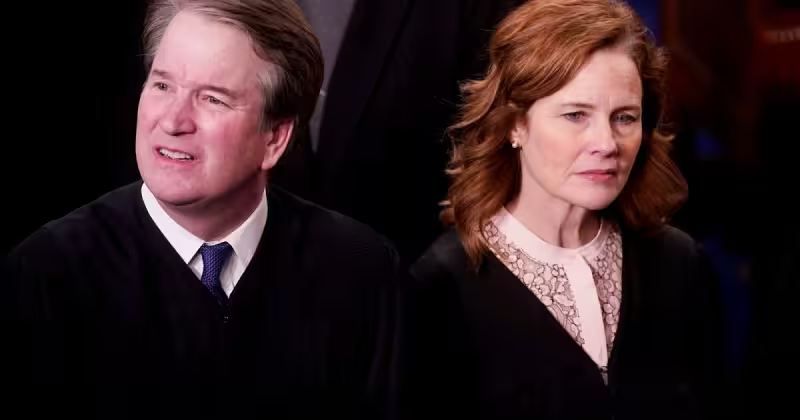
Justices Brett Kavanaugh and Amy Coney Barrett joined the court’s three Democratic appointees in the majority, keeping Smith’s protection intact for now. Alabama had wanted the justices to resolve whether courts may look at the cumulative effect of multiple IQ scores when a prisoner claims intellectual disability.

Smith was convicted in the 1997 killing of Durk Van Dam, and Alabama has been pressing to carry out his execution. The Supreme Court has already ruled that intellectually disabled people convicted of capital crimes may not be executed, which made the IQ issue central to the case.


The dismissal mattered because the court had taken the case after agreeing to answer a question lower courts face often in death penalty litigation: how to treat several IQ scores that do not line up neatly. A dismissal as improvidently granted, or DIG, comes after the court has already agreed to review a case, studied the briefs and heard argument, but then decides not to issue a merits ruling.
That left the court where it began, with no new rule for judges who must weigh conflicting scores in capital cases. Sonia Sotomayor, joined by Ketanji Brown Jackson, said the court was not equipped in this case to provide any meaningful guidance on how courts should assess multiple IQ scores and warned against treating the Eighth Amendment as if it prescribed a single formula for weighing them. She also said the record was incomplete and potentially misleading.
Samuel Alito dissented, joined by Clarence Thomas, Neil Gorsuch and Chief Justice John Roberts. He said the court shies away from its obligation to provide workable rules for capital cases and, in doing so, disserves its own death-penalty jurisprudence, states’ criminal justice systems, lower courts and victims of horrific murders.
For Alabama, the ruling means the fight to execute Smith is not over, but Thursday’s decision was still a setback. The state asked for a clear standard; the court instead left the issue unresolved and let the lower court’s protection for Smith stand.



