



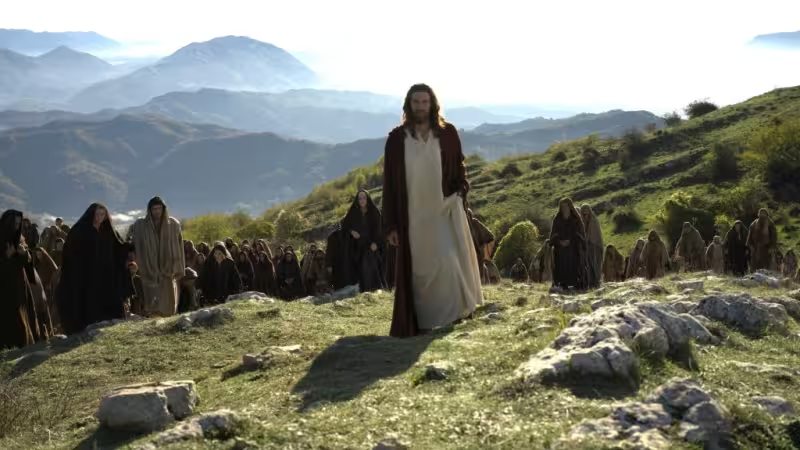
Lionsgate has pushed back the release dates for Mel Gibson’s two-part follow-up to The Passion of the Christ, announcing on Thursday that Part One will open May 6, 2027, and Part Two will arrive May 25, 2028.
The studio also released the first look at The Resurrection of the Christ the same day, and confirmed that principal photography wrapped after 134 days of shooting across Italy. Filming took place in Rome, Bari, Ginosa, Craco, Brindisi and Matera, and the production will be released by Lionsgate in North America and the U.K. while Icon will handle Australia and New Zealand.

The new dates replace the previous schedule that had Part One set for March 26, 2027, and Part Two for May 6, 2027. The move creates a long gap between the two films and gives the production roughly a year between the North American openings of each installment.
The shoot featured a notable recasting: Jaakko Ohtonen will play Jesus in the new films, replacing Jim Caviezel from the 2004 picture. Mariela Garriga has been announced in the role of Mary Magdalene. The production was financed by Gibson for $30 million.
These are not small changes. The original film from 2004 opened with an $83 million weekend and went on to gross more than $610 million worldwide on a $30 million budget, a financial benchmark any follow-up will be measured against. Lionsgate’s first look and the extended timetable make clear the studio is treating the two films as a global, multi-year release plan.
The Resurrection of the Christ is framed as a continuation of that earlier story: the new films are set three days after Christ’s crucifixion on Good Friday and will be released as two separate features. Gibson and his producers have described the project as an ambitious return to the same territory he explored with The Passion of the Christ, and the scale of the shoot — more than four months on location in Italy — underlines that ambition.
There is friction in the rollout. Recasting the central figure invites immediate comparison to the 2004 film, and splitting the story into two releases raises expectations about the scope and payoff audiences will demand. Gibson has spoken repeatedly about the project as a long-held mission and as a demanding, sometimes uncertain undertaking; studio executives have praised the visuals coming from the set as painterly and grand in scale. That mixture — a director who calls the work a mission and a production that needed time, money and new casting to realize it — is the beating heart of the story now.
For viewers and the marketplace, the schedule change matters because it gives the filmmakers additional months to finish effects, editing and marketing for what the studio has positioned as an epic event. It also staggers the two releases to create breathing room between installments, a strategy that will test whether audiences will return for a second installment more than a year after the first.
With production complete and a first look in circulation, the next concrete moment is fixed: Part One opens May 6, 2027, followed by Part Two on May 25, 2028. For Gibson, who has called the project an artistic mission he has carried for over two decades and whose original financed picture delivered enormous box-office returns in 2004, the new dates create the space to finish an undeniably ambitious vision — and set the clock for the moment audiences will decide whether he has pulled it off.



