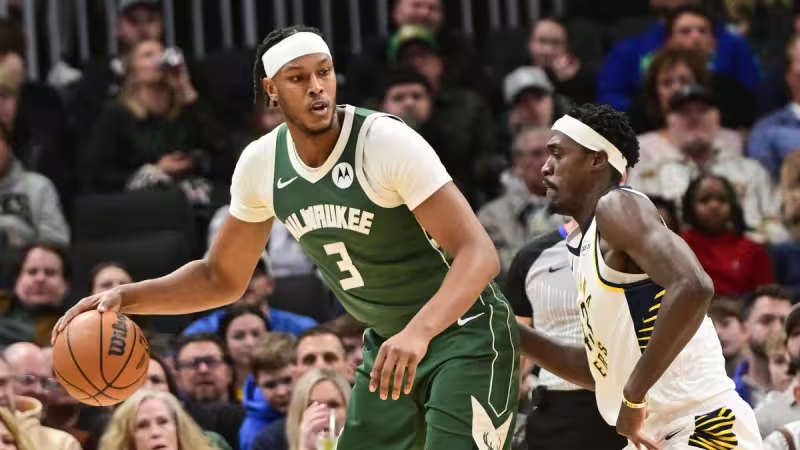
Myles Turner said on his Game Recognize Game podcast that the Milwaukee Bucks ran a loose, often chaotic operation last season under Coach Doc Rivers.
Turner, who signed a four-year, $108 million free agent contract with the Bucks last summer after leaving the Indiana Pacers following 10 seasons, did not hold back. “(Coach) Doc Rivers, he didn't fine anybody,” Turner said. “Guys were late all the time. Guys showed up to (watch) film whenever they wanted to show up. Guys were missing meetings. It was one of the craziest things I've ever experienced.”

He offered a blunt example of travel disorganization: “If the plane took off at 2 o'clock, we weren't leaving until 4:30. I'm being so serious, bro. It was crazy. It got to the point where I knew not to show up until an hour after they said the plane was taking off.” Turner also singled out Giannis Antetokounmpo's timetable: “Giannis (Antetokounmpo) showed up whenever he wants, really. I think that this just kind of came with the territory.”
The weight of those comments lands against clear, hard numbers. The Bucks finished 32-50 and missed the playoffs, and Rivers has since been replaced by Taylor Jenkins, who previously coached the Memphis Grizzlies for six seasons. Giannis Antetokounmpo — a two-time league MVP who has played for the Bucks for 13 seasons — remains the central figure in what Turner described; Milwaukee has reportedly been listening to trade offers for Antetokounmpo.



Turner framed his resignation to the situation plainly: “Once I saw what was going down, I just said, 'Man, more power to you.'” He also reacted to a comparison offered by co-host Breanna Stewart — who noted the New York Liberty assess fines on missed box outs on free throws — by saying he would welcome similar accountability. “Honestly, that's a good one,” Turner said, later adding, “I'm not mad at that at all.”
The context is simple and immediate: Turner joined the Bucks last summer on a sizable contract and found a team whose internal rules, by his account, failed to match the standard many expect when a franchise fields a player of Antetokounmpo's stature. That mismatch helps explain why a 32-50 record produced not only a coaching change but, apparently, trade-market activity around the franchise's cornerstone.
The tension in Turner's account is that public and private expectations for the Bucks diverge sharply. On the one hand, the franchise still centers on a two-time league MVP with 13 seasons on his resume; on the other, Turner describes a day-to-day operation where meetings, film and travel were treated as optional. Replacing Rivers with Jenkins suggests Milwaukee sought structure; the reports that the team is listening to trade offers for Antetokounmpo signal a competing, more disruptive path.
Turner's podcast comments force a clear choice for the organization: double down on discipline under a coach with a longer track record of building systems, or accept a reset that could include moving its franchise player. Either path will determine whether the Bucks' offseason is defined by an internal overhaul or by transactions aimed at answering the same question Turner raised aloud — how do you turn a roster that finished 32-50 into a consistent contender?