




Snap introduced SPECS, its new augmented reality glasses, at Augmented World Expo 2026, pitching them as fully standalone hardware built to bring AI assistance, work tools, entertainment and shared experiences into the world around users.
The company disclosed precise hardware and display details that push the product beyond prototype language: SPECS use Snap’s proprietary liquid crystal on silicon display system, deliver a 51-degree field of view and 16 million colors, and — Snap said — can feel like a 24-inch desktop monitor when working or a 115-inch home cinema screen placed about 10 feet away when watching a movie. Snap emphasized the glasses are fully standalone with no puck and no tether.

Snap framed the design around practical wearability. The frames are made from high-performance Swiss TR90 polymer and come in two sizes: a 47 mm model that weighs 132 grams and a 52 mm model that weighs 136 grams. Removable inserts support a wide range of prescriptions, and electrochromic lenses shift from clear to tinted in 10 seconds. ‘‘We built SPECS to bring AI assistance, work tools, entertainment, and shared experiences into the world around us, helping people create, connect, learn, and get things done while staying present,’’ Snap said.
The company also detailed how the optics work. A new waveguide built from billions of invisibly small nanostructures routes images into the eye — Snap said more than 10,000 of those nanostructures can fit on the tip of a single hair — and it tied the approach to materials used in aviation, saying SPECS use the same advanced technology found in Boeing 787 Dreamliner windows.
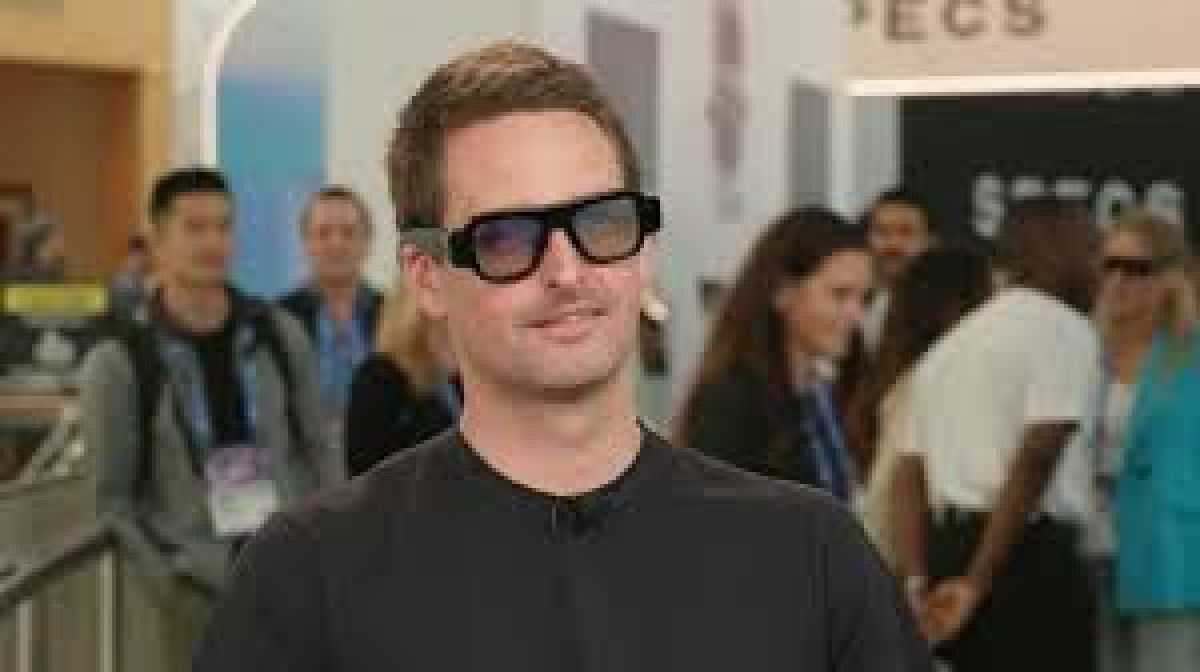
Those technical claims are the weight of the announcement: proprietary LCOS displays, a broad color palette, a wide field of view and a waveguide system that Snap says miniaturizes complex optics into a glasses form factor. The company contrasted SPECS with today’s options, saying current AI glasses are lightweight but limited, while headsets are powerful but can feel isolating and cumbersome. Snap summarized the approach bluntly: ‘‘The promise of augmented reality isn't putting screens everywhere.’’
But Snap did not treat the product launch as the end of a simple engineering sprint. The company said it has been building toward augmented reality for more than a decade and that the goal was to build something powerful enough for augmented reality and light enough to be worn for hours. At the same time, it acknowledged the core difficulty of the effort: building a computer that fits into glasses is incredibly difficult, even as the company insists these SPECS are light enough for extended wear.
The practical consequences for users are immediate in concept: glasses that claim to surface AI assistance and shared experiences without a phone or tether could change how people access information and entertainment in daily life. The removable prescription inserts and two-size frame options aim to broaden that reach beyond early-adopter use cases, and the electrochromic lenses add a utility layer for bright environments.
Important details remain missing from the announcement. Snap provided hardware and optical specifications but did not give a release date, availability window or price. That omission matters: a standalone pair of AR glasses with the listed display and waveguide claims will be judged on how affordable and accessible it actually becomes for everyday users.
The most consequential unanswered question now is when Snap will put SPECS on sale and at what price, because those facts will determine whether the product can move augmented reality from a novelty into a device people use for work, learning and entertainment outside demos and trade-show floors.



