



A federal judge on Thursday vacated the Us Energy Department’s cancellation of $82.1 million in clean energy grants, clearing the way for the department to restore funding for 11 awards that had been terminated in October 2025. Judge Amit Mehta said in his ruling, “The Court enters judgment in favor of Plaintiffs,” and added, “This is a final, appealable judgment.”
The plaintiffs, a coalition led by the American Institute of Chemical Engineers, had challenged the terminations of grants tied to projects in New York, Oregon, Connecticut, Minnesota and Colorado. Their case centered on seven department awardees, including the New Buildings Institute, which lost four Oregon grants, and Proton Energy Systems Inc., which had a $6.1 million award cancelled. The disputed awards were all issued by the department’s Office of Energy Efficiency and Renewable Energy.

The ruling lands after months of fallout from the October 2025 cancellations, when DOE’s full set of terminations wiped out more than $7.5 billion in financial awards to clean energy projects in states that voted for former Vice President Kamala Harris. The plaintiffs said the department did not dispute that a primary reason for the cuts was the political lean of the states where the grantees were located, a claim that put the case squarely at the intersection of grant administration and partisan targeting.
That allegation was sharpened by a separate case resolved in January, when DOE was ordered to reverse $27.6 billion in grant cancellations. The plaintiffs said that precedent showed the department had already been forced to undo a broad sweep of terminations, and they pointed to a similar pattern in this dispute: a set of awards cut in October, then challenged in court before a judge found for the grantees.
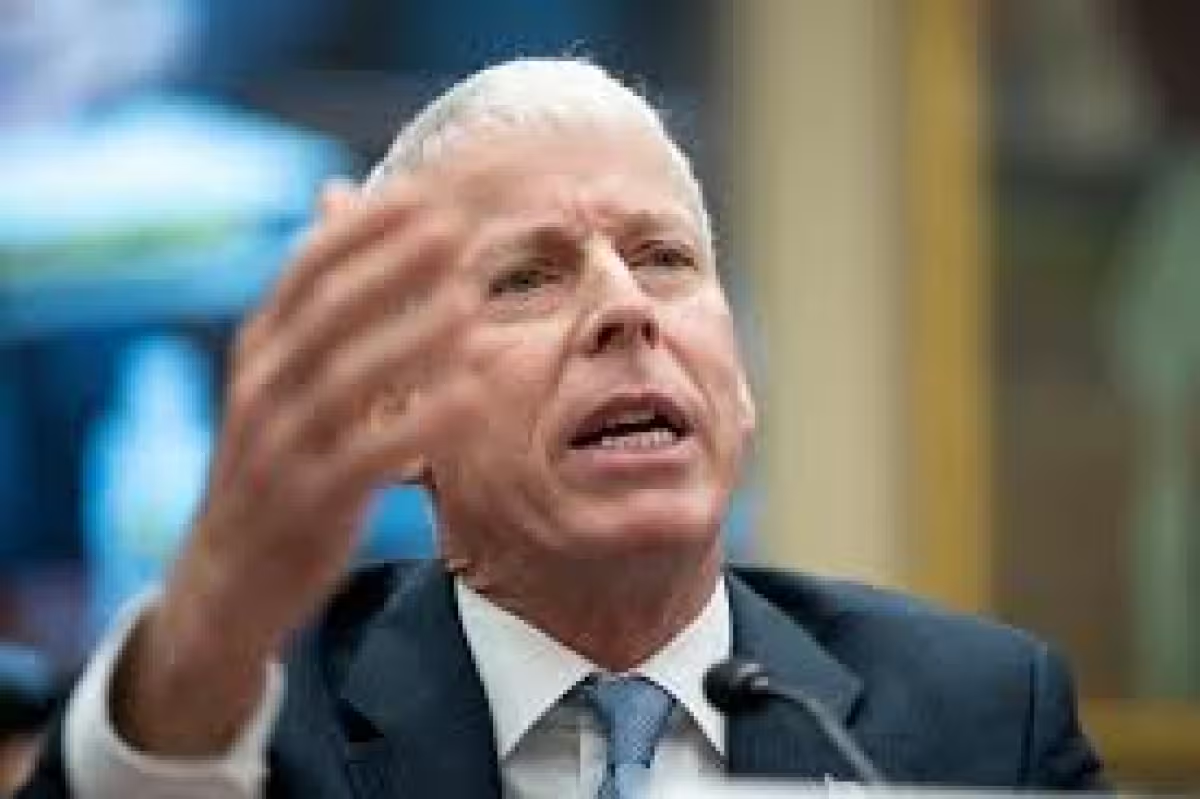
The department’s own public defense has not matched the plaintiffs’ theory of politics. On Wednesday, during a House Science, Space, and Technology Committee hearing, Rep. Gabe Amo asked Energy Secretary Chris Wright when funding would be restored to projects that were wrongfully terminated. Wright replied, “We did not involve politics in the decision-making of our review process. Hands down,” and then added, “I keep hearing that charge. It’s bulls–t, we’re going to say it a million times.”
Still, the record includes a direct paper trail from the period of the cuts. Russell Vought posted on X that nearly $8 billion in Green New Scam funding was being cancelled and listed states including California, Colorado, Connecticut, Minnesota, New York and Oregon. The plaintiffs cited that post in their April complaint, using it to argue that the terminations were never just about merit or program review.
What happens next is narrower than the politics around it but still important: the Us Energy Department is expected to reinstate the $82.1 million, though the timing was not spelled out in the ruling. Mehta’s order leaves the department with a final, appealable judgment and a clear mandate to reverse the cancellations that had already frozen work on clean energy projects in several states.
The grants were part of the department’s Office of Energy Efficiency and Renewable Energy portfolio, now consolidated into the Office of Critical Minerals and Energy Innovation. The cancelled projects included work on critical minerals, materials recovery and hydrogen production through electrolysis, making the ruling more than a bookkeeping reversal. It restores funding to projects that had already been cut off, and it closes one of the more pointed disputes over how the federal government handled its October 2025 clean energy terminations.



